
 Trade & Sourcing
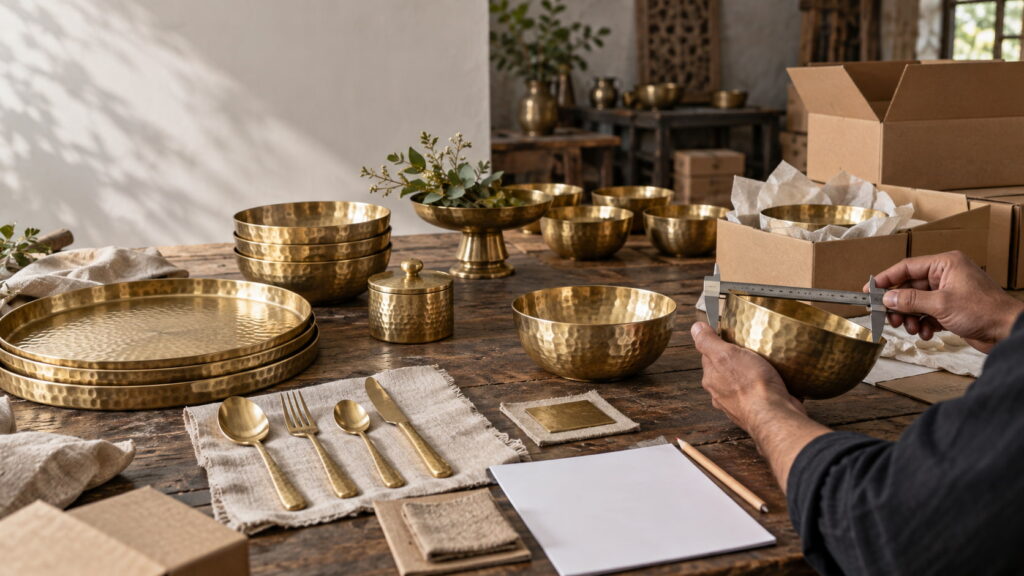
India has a long history of working metal by hand. Brass is hammered into serving pieces. Copper is shaped into bowls and trays. Metal sheets are cut, formed, etched, polished and finished by craftspeople whose work sits somewhere between manufacturing and making.
For an international buyer, however, finding beautiful products is only the beginning.
A successful order also depends on material specifications, samples, dimensions, finish consistency, food-contact requirements, packaging, minimum quantities, production timing, export documentation and a clear agreement about who is responsible for freight and import costs.
This guide explains how to source handcrafted metalware from India with fewer surprises, whether you are buying for a retail collection, hospitality project, interior scheme, gifting programme or wholesale business.
India already has a substantial international handicrafts trade. The Export Promotion Council for Handicrafts reports total Indian handicraft exports of ₹33,168.48 crore in 2025–26, with art metalware accounting for ₹4,349.83 crore.
That export base creates opportunities for buyers, but it does not remove the need for careful sourcing.
1. Start With the Product, Not the Supplier
A sourcing enquiry works better when the buyer can describe what is actually required.
Before contacting an Indian metalware supplier, define the basics:
- Product category
- Intended use
- Preferred metal
- Approximate dimensions
- Required quantity
- Finish or surface treatment
- Target market
- Packaging requirements
- Branding requirements
- Target delivery period
- Expected price range
A request for “200 brass trays” leaves too many questions unanswered.
A request for “200 round hand-finished brass serving trays, approximately 30 cm diameter, for retail sale in the UK, individually packed, with buyer branding” gives a supplier enough information to begin a useful commercial discussion.
The more precise the brief, the easier it becomes to compare quotations fairly.
2. Choose the Material According to Use
Metal is not one product category.
Brass, copper, bronze, aluminium, iron, stainless steel and tin behave differently, age differently and suit different applications. Even within a single material family, alloy composition, sheet thickness, lining, coating and finish can change how the final object performs.
For example, Lume Loam’s current collection includes handcrafted pieces across materials such as brass, copper and tin, covering tableware, serveware, cutlery, containers and decorative objects.
Before placing an order, ask:
What exactly is the base material?
“Gold finish” describes appearance, not necessarily the metal underneath it.
Is the item solid metal, plated or coated?
A solid brass object and a brass-plated object are not commercially equivalent.
What is the expected thickness or weight?
Two products of identical dimensions can feel and perform very differently.
Is the interior lined?
This can matter when the product is intended for food or drink.
How will the finish change with use?
Some buyers want a surface that develops character; others need greater visual consistency across repeated hospitality or retail orders.
Material should therefore be written into the specification rather than assumed from photographs.
3. Understand What “Handmade” Means for a Bulk Order
Handmade products should not be evaluated in exactly the same way as pieces coming from a fully automated production line.
Hammer marks may move slightly.
Patina may develop differently.
A hand-finished edge may not be identical from one unit to the next.
Subtle differences in colour, texture, dimensions and weight can be part of the making process rather than evidence of poor workmanship.
Lume Loam, for example, explains that its handcrafted, hammered, sculpted and hand-finished pieces can show small variations in texture, colour, patina, dimensions or weight.
That does not mean a buyer should accept unlimited inconsistency.
The commercial question is:
Which variations are part of the craft, and which variations would make the product unacceptable?
Agree this before production.
A buyer may accept minor differences in hammer texture but require:
- A consistent overall diameter
- Stable bases
- Smooth food-contact surfaces
- No sharp edges
- A defined colour range
- Consistent logo position
- Correct piece count
- Packaging that fits every unit
The aim is not to remove the hand of the maker. It is to define a repeatable quality standard around it.
4. Ask for a Detailed Sample Before Approving Production
Photography is useful for discovery. It is not enough for approving a meaningful wholesale order.
Whenever practical, evaluate a physical sample.
Check:
- Overall size
- Weight
- Balance
- Wall or sheet thickness
- Surface texture
- Finish
- Colour
- Edge quality
- Joinery
- Handles
- Feet or bases
- Engraving
- Branding
- Packaging
- Product stability
- Intended functionality
If the object will be used in a restaurant, hotel or retail environment, test it in that environment rather than simply looking at it on a desk.
Put a tray on a table.
Stack the bowls.
Handle the cutlery.
Check how easily fingerprints show.
Open and close the packaging.
Look at the product in natural and artificial light.
A sample should answer practical questions that a product photograph cannot.
Keep an Approved Reference Sample
Once the sample is accepted, record the approval.
Keep photographs, measurements and written specifications. Where appropriate, both buyer and supplier should be clear about which sample represents the agreed standard.
This gives the production team something concrete to work towards and gives the buyer a meaningful reference during final inspection.
5. Build a Product Specification Sheet
For repeat orders, memory is not a quality-control system.
Create a written specification for every important SKU.
A useful metalware specification can include:
| Specification | Example Information |
| Product | Serving tray |
| Material | Brass |
| Dimensions | Diameter × height |
| Weight | Target weight or permitted range |
| Surface | Hand-hammered |
| Finish | Agreed finish reference |
| Edge | Smooth / rolled / specified profile |
| Logo | Position and dimensions |
| Packaging | Individual protective pack |
| Carton | Units per master carton |
| Intended use | Decorative / serving / food contact |
| Quantity tolerance | Agreed with supplier |
| Quality standard | Based on approved sample |
The exact fields will depend on the object.
For handmade work, a specification should provide enough control for commercial consistency without pretending that every hand-worked surface will be microscopically identical.
6. Verify the Supplier’s Export Readiness
Manufacturing a good product and exporting one successfully are different skills.
An Indian commercial exporter will generally need an Importer-Exporter Code, or IEC, unless an exemption applies. DGFT describes the IEC as a key business identification number required for export from or import into India.
For a substantial international order, buyers can ask practical questions such as:
- Who will be the exporter of record from India?
- Has the supplier handled your destination market before?
- Who prepares the export documentation?
- Can the supplier work with your nominated freight forwarder?
- How are cartons marked?
- How is the HS classification established?
- Can shipment dimensions and weights be supplied before booking freight?
- Who coordinates inspection if required?
- What documentation will accompany the goods?
A buyer does not need to become an Indian customs specialist.
The purpose is simply to establish that the commercial and logistics process has been considered before the goods are ready to leave the workshop.
7. Check the Rules in Your Destination Market
One of the biggest mistakes in international sourcing is assuming that a product acceptable in one country will automatically satisfy the requirements of another.
Requirements can depend on:
- Destination country
- Product material
- Intended use
- Food contact
- Coatings or finishes
- Labelling
- Packaging
- Country-of-origin marking
- Applicable chemical or material limits
This is especially important for metal tableware and drinkware.
European Union
The European Commission classifies kitchenware and tableware intended to come into contact with food as Food Contact Materials. Materials sold in the EU must comply with the general safety framework under Regulation (EC) No 1935/2004, alongside applicable good manufacturing practice and other material- or country-specific requirements.
United States
Material and intended use also matter in the US. As one example, the FDA Food Code limits the use of copper and copper alloys such as brass in contact with foods below pH 6, including examples such as vinegar, fruit juice and wine. The Food Code itself is a model used by regulatory jurisdictions rather than a universal product certification.
US Customs and Border Protection also notes country-of-origin marking requirements for imported goods, subject to applicable exceptions and product-specific rules.
The practical lesson is simple:
Do not ask only, “Is this food safe?”
Instead ask:
“What requirements apply to this exact product, material, intended use and destination market, and what evidence do we need?”
Testing, declarations or certificates should be agreed according to the buyer’s market and product rather than treated as a generic promise.
8. Discuss MOQ After the Product Is Defined
Buyers often begin by asking:
“What is your MOQ?”
It is an understandable question, but the answer may change according to the product.
Minimum order quantity can be influenced by:
- Existing design versus new development
- Material purchasing
- Tooling
- Casting or forming process
- Finish
- Custom colour
- Engraving
- Private-label packaging
- Number of SKUs
- Carton configuration
- Production scheduling
A better discussion begins with the collection.
For example:
300 total pieces across four existing designs may be commercially different from 300 pieces across fifteen newly developed designs.
Ask whether the MOQ applies:
- Per design
- Per size
- Per finish
- Per colour
- Per SKU
- Per order
This makes quotation comparisons much more meaningful.
9. Understand the Full Price, Not Just the Unit Price
A low unit cost does not automatically produce a low landed cost.
The Export Promotion Council for Handicrafts notes that export pricing can include manufacturing, packing, financing, documentation, transport to port, freight-related handling and other commercial costs.
For a global buyer, the complete calculation may involve:
**Product price
- development or sampling
- branding
- retail packaging
- export cartons
- inland transport
- freight
- insurance
- import duty
- taxes
- customs clearance
- local delivery**
That is why two quotes should only be compared when they are based on similar specifications and commercial terms.
A beautifully priced product can become expensive if it occupies too much carton space, requires excessive protective material or arrives with avoidable damage.
10. Agree the Incoterm Clearly
Do not leave freight responsibility to a phrase such as “shipping extra”.
International transactions commonly use Incoterms® 2020, published by the International Chamber of Commerce. The rules help define obligations, costs and the point at which risk transfers between seller and buyer. There are 11 Incoterms® rules in the current 2020 edition.
The appropriate term depends on the shipment and commercial arrangement.
The important point for a buyer is that the quotation should clearly identify the agreed term and the named place or port.
For example, simply writing “FOB” without identifying the port leaves important information unclear.
Incoterms also do not replace the full sales contract. ICC specifically notes that the rules allocate defined delivery responsibilities but are not themselves a substitute for a contract of sale.
11. Confirm Export Documentation Before Dispatch
For exports of goods from India, DGFT identifies core documents including the transport document, a commercial invoice-cum-packing list and a shipping bill or bill of export. Additional documentation can apply according to the goods, regulations and destination.
Depending on the transaction, buyers may encounter documents such as:
- Commercial invoice
- Packing list
- Bill of lading or airway bill
- Shipping bill
- Certificate of origin where applicable
- Product-specific certificates or test reports where required
- Insurance documentation where applicable
Do not assume every shipment requires every document on this list.
Certificates of origin, for example, can depend on the trade arrangement and whether preferential treatment is being claimed. DGFT operates electronic systems for both preferential and non-preferential certificates of origin.
The documentation requirement should therefore be confirmed against the actual product, HS classification, destination and trade terms.
12. Treat Packaging as Part of Product Development
Handcrafted metal may be durable, but a finished surface can still scratch, dent, rub or tarnish during a long supply chain.
Packaging therefore has two jobs:
protect the object and use space intelligently.
Discuss:
- Individual wrapping
- Surface protection
- Separation between stacked pieces
- Inner cartons
- Master cartons
- Moisture protection where appropriate
- Void space
- Carton strength
- Carton dimensions
- Gross and net weight
- Palletisation if needed
- Retail packaging
- Barcode or label position
- Shipping marks
For products that nest, carton design can materially affect freight efficiency.
But nesting should never allow finished surfaces to rub against each other.
Request a proposed packing method before production is complete, particularly when freight cost is sensitive to shipment volume.
13. Plan Quality Control Before the Order Is Finished
Quality inspection should not begin when thousands of pieces are already packed.
Agree beforehand:
- What will be checked?
- At what stage?
- Against which approved specification?
- How much variation is acceptable?
- What happens if a defect is found?
Checks for handcrafted metalware might include:
Material
Is the specified base material being used?
Dimensions
Are important dimensions within the agreed range?
Finish
Does the production broadly match the approved appearance?
Function
Does the item sit, stack, pour, hold or serve as intended?
Workmanship
Are edges safe and joins properly finished?
Quantity
Does the carton and total piece count match the order?
Branding
Are logos, labels and packaging correctly positioned?
Packing
Are finished surfaces separated and protected?
The exact inspection criteria should follow the product.
A decorative centrepiece does not need the same functional checks as a drinking vessel.
14. Understand Lead Time in Stages
“Production takes six weeks” is not the same as “the order will arrive in six weeks.”
A global sourcing calendar may include:
Product development → Sampling → Sample approval → Material procurement → Production → Finishing → Inspection → Packing → Export clearance → International freight → Import clearance → Final delivery
Build margin into a launch schedule.
This is particularly important when sourcing for:
- Hotel openings
- Seasonal retail collections
- Weddings or events
- Corporate gifting
- Holiday sales
- Restaurant launches
A realistic delivery plan should work backwards from the date the buyer needs the goods, not simply forwards from the factory start date.
15. Start Smaller Before Scaling
For a new supplier relationship, a controlled first order can reveal more than a long presentation.
It allows the buyer to understand:
- Communication
- Sampling accuracy
- Production consistency
- Packing quality
- Documentation
- Dispatch coordination
- Actual customer response
- Reorder potential
A successful first order then creates a much stronger basis for expanding the collection or increasing quantity.
Large commitments make more sense once both parties understand how the other works.
A Practical Checklist for Sourcing Handcrafted Metalware From India
Before issuing a purchase order, confirm the following:
Product
- Product design approved
- Material specified
- Dimensions confirmed
- Weight or acceptable range confirmed where relevant
- Finish approved
- Intended use established
Sample
- Physical or agreed pre-production sample reviewed
- Reference photographs retained
- Acceptable handmade variation defined
Commercial Terms
- Quantity confirmed
- MOQ understood
- Unit price confirmed
- Currency confirmed
- Payment terms confirmed
- Incoterm and named place confirmed
- Production timeline agreed
Compliance
- Destination-market requirements checked
- Food-contact requirements checked where applicable
- Testing requirements agreed where applicable
- Labelling requirements confirmed
- Country-of-origin requirements checked
- HS classification reviewed by the responsible trade parties
Packaging & Shipping
- Individual packaging agreed
- Master carton configuration agreed
- Carton measurements available
- Shipping marks confirmed
- Freight responsibility confirmed
- Insurance responsibility confirmed
Documentation
- Commercial invoice requirements understood
- Packing list requirements understood
- Transport document arranged
- Certificate of origin requirement checked
- Any destination-specific documents identified
Common Mistakes Global Buyers Should Avoid
Most sourcing problems are not caused by one dramatic mistake. They begin with small assumptions.
Avoid:
Buying from photographs alone.
Approve the physical product whenever the order justifies sampling.
Using vague material names.
Specify the base metal, not only the colour.
Expecting handmade pieces to be identical.
Define reasonable tolerances instead.
Accepting unlimited handmade variation.
Craft character and poor quality are not the same thing.
Ignoring destination regulations until dispatch.
Compliance questions belong near the beginning of product development.
Comparing unit prices without comparing trade terms.
A lower factory price may produce a higher landed cost.
Leaving packaging until the end.
The carton affects both protection and freight.
Assuming one certificate works everywhere.
Requirements depend on the product, its use and the destination.
Ordering too many new SKUs at once.
A more focused first collection is often easier to control.
Sourcing Handcrafted Metalware With Lume Loam
Lume Loam works in a world of objects made for the table and the home.
Its current collection spans handcrafted tableware, serveware, drinkware and decorative objects, including bowls, trays, cutlery, containers and centrepieces across metals such as brass, copper and tin.
For a trade buyer, the useful starting point is not simply sending a message asking for a catalogue.
Share the context of the order.
Tell us:
- What you are sourcing
- Approximate quantity
- Destination country
- Intended use
- Preferred materials or finishes
- Whether existing products or custom requirements are being considered
- Packaging or branding requirements
- Required delivery period
Good sourcing begins with clear information on both sides.
Because when an object has travelled from an artisan’s bench in India to a shop, hotel, restaurant or home thousands of kilometres away, what matters is not only how it looks when it arrives.
It matters how well every decision before that moment was made.
Frequently Asked Questions
Is India a good country for sourcing handcrafted metalware?
India has a substantial handicrafts export sector and an established international market for art metalware. EPCH reports ₹4,349.83 crore of art-metalware exports for 2025–26. Buyers should still evaluate individual suppliers for product quality, export experience, commercial terms and compliance relevant to their destination.
What metalware can international buyers source from India?
The market includes products such as tableware, serveware, bowls, trays, cutlery, drinkware, decorative objects and other metal home accessories. Available materials and manufacturing techniques vary considerably between suppliers.
Should I order a sample before placing a wholesale metalware order?
For a new product or supplier, sampling is strongly advisable. A physical sample allows a buyer to assess material, scale, weight, workmanship, finish, function and packaging before committing to a larger quantity.
Are handmade metal products supposed to have variations?
Small differences can naturally result from hand forming, hammering, etching, polishing and finishing. Buyers and suppliers should still agree acceptable tolerances so that natural variation does not become uncontrolled inconsistency.
What documents are required when importing metalware from India?
On the Indian export side, DGFT identifies core documents including a transport document, commercial invoice-cum-packing list and shipping bill or bill of export. Other documentation can depend on the product and destination. Importers should separately confirm the requirements in their own country.
How should buyers check whether Indian metal tableware is suitable for food use?
Check the exact material, construction, lining or coating, intended food type and regulations applying in the destination market. Food-contact requirements differ between jurisdictions, so a general “food-safe” statement should not replace market-specific compliance review.