
 Private Label & Custom
Launching a private-label tableware collection does not necessarily begin with a factory catalogue and your logo placed on the box.
The better collections begin with a point of view.
Who is the customer?
What should the objects feel like in the hand?
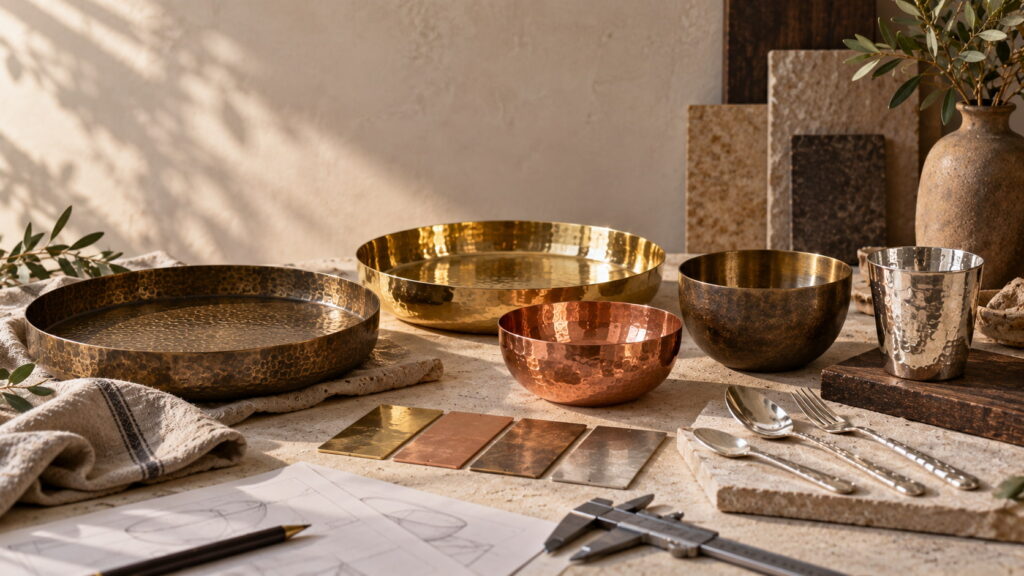
Which metals belong in the range?
Which shapes should repeat?
How much variation is acceptable?
What should the packaging communicate?
And, perhaps most importantly, what makes the collection recognisably yours rather than another assortment of products sourced from the same market?
India offers a substantial manufacturing and craft base for brands looking to develop handcrafted metalware. According to the Export Promotion Council for Handicrafts, India exported ₹33,168.48 crore of handicrafts in 2025–26, including ₹4,349.83 crore of art metalware. The United States was the largest named destination for art metalware in EPCH’s current country data, with significant trade also going to Germany, the United Kingdom, UAE and the Netherlands.
For retailers, homeware brands, department stores, hospitality companies and design-led businesses, that creates an established sourcing base.
But finding a supplier is only one part of building a successful private label metalware collection in India.
The real work is turning an idea into a repeatable product system.
This guide takes that process from the first collection brief through product development, samples, branding, packaging, compliance, bulk production, quality control and reorders.
What Is Private Label Metalware?
Private label metalware is metalware manufactured by one business and sold under another company’s brand.
The retailer or brand generally controls the market-facing identity of the product, which can include:
- Brand name
- Product name
- Packaging
- SKU
- Barcode
- Photography
- Product description
- Retail pricing
- Collection story
The amount of product customisation varies considerably.
One private-label project may involve placing a retailer’s packaging around an existing supplier design.
Another may involve changes to:
- Dimensions
- Material
- Surface texture
- Finish
- Handle
- Engraving
- Packaging
- Product combinations
A third may involve developing a completely new object.
That is why private label should not be confused with one specific manufacturing model.
Private Label vs White Label vs Custom Manufacturing
These terms are often used loosely, so it helps to separate them.
White Label
A relatively standard product may be offered to several businesses, with each company applying its own branding.
There may be little or no product-level customisation.
Example:
An existing brass bowl supplied in standard dimensions, placed inside packaging carrying the retailer’s own brand.
Private Label
The supplier manufactures products that the retailer sells under its own brand.
The product may be standard, modified or developed specifically for the buyer.
Example:
An existing serving tray with a custom finish, branded packaging and a retailer-specific set configuration.
Semi-Custom Development
An existing design becomes the starting point, but selected elements are modified.
For example:
- Diameter
- Finish
- Hammer pattern
- Engraving
- Handle
- Packaging
This can provide more differentiation without developing every product from zero.
Fully Custom Development
A new product is developed around the buyer’s own brief.
This may require:
- Drawings
- Tooling
- Prototypes
- Multiple samples
- Testing
- Longer development time
- Higher initial quantities
No approach is automatically better.
The right route depends on the brand, launch timeline, budget, quantity and level of differentiation required.
Start With the Brand, Not With 500 Supplier Products
One of the easiest ways to create an unfocused private-label collection is to begin by browsing hundreds of available products and choosing everything that looks attractive.
The result may contain good individual pieces but little relationship between them.
Instead, write a collection brief before product selection begins.
Define:
Customer
Who will actually buy these pieces?
For example:
- Design-conscious homeowners
- Gifting customers
- Premium department-store shoppers
- Boutique-hotel buyers
- Everyday tableware customers
Price Position
Is the brand:
- Accessible?
- Mid-market?
- Premium?
- Luxury?
The target retail price influences product weight, complexity, packaging and landed-cost requirements.
Material Direction
Will the range focus on:
- Brass
- Copper
- Bronze
- Tin
- Mixed metals
- Another metal family
Visual Language
Should the collection feel:
- Bright
- Aged
- Minimal
- Sculptural
- Traditional
- Contemporary
- Formal
- Relaxed
Product Categories
For example:
- Bowls
- Trays
- Cutlery
- Serveware
- Drinkware
- Containers
- Centrepieces
- Table accessories
Once those decisions exist, supplier conversations become much more focused.
Step 1: Build the Collection Architecture
A collection should not simply be a list of SKUs.
Think about how products relate to each other.
A practical first collection might contain:
Hero Product
The object that represents the collection visually.
Perhaps a distinctive hand-hammered serving tray.
Core Products
Items with broader everyday use.
For example:
- Serving bowl
- Small bowl
- Cutlery set
- Container
Supporting Pieces
Objects that expand the story without carrying most of the commercial risk.
Perhaps:
- Napkin accessory
- Small cup
- Decorative tabletop object
This structure gives the range hierarchy.
It also prevents every item from trying to be the hero.
Step 2: Decide Whether to Adapt Existing Products or Develop New Ones
You do not have to design every piece from zero to create a distinctive private-label collection.
There are advantages to both routes.
Existing Designs
Useful when:
- Launch time is limited
- Quantities are being tested
- The product already suits the brief
- Lower development complexity is desirable
Differentiation can come through:
- Product selection
- Finish
- Sets
- Packaging
- Photography
- Brand positioning
Modified Existing Designs
Useful when an existing product is close but not quite right.
Possible changes might include:
- Diameter
- Height
- Finish
- Texture
- Handle
- Engraving
New Designs
Useful when the product itself needs to create stronger brand differentiation.
This route may involve more development, sampling and tooling.
For many first-time private-label buyers, a combination works well:
core proven forms + a smaller number of distinctive custom pieces.
Step 3: Do Not Copy Another Brand’s Product
Reference images are useful.
Direct copying is not a good product-development strategy.
If you send a supplier a competitor product and say:
“Make exactly this.”
you may create:
- Intellectual-property risk
- Weak brand differentiation
- Dependence on someone else’s design language
- A collection customers can easily compare on price
Instead, explain what you like about the reference.
For example:
“We like the low profile.”
“We like the broad rim.”
“We want this level of surface texture.”
“We like the proportion between handle and tray.”
Then develop your own solution.
Your references should communicate direction, not replace design.
Step 4: Select Materials Intentionally
Metal selection affects more than colour.
It can influence:
- Weight
- Feel
- Cost
- Surface ageing
- Cleaning
- Intended use
- Customer education
- Compliance
For a handcrafted collection, buyers might consider materials such as brass, copper or bronze.
Brass
Typically offers a warm yellow-gold visual direction.
Works across:
- Serveware
- Bowls
- Trays
- Cutlery
- Containers
- Decorative pieces
Copper
Provides a recognisable reddish warmth and stronger visual character.
Useful for:
- Accent products
- Bowls
- Drinkware
- Serving pieces
- Statement objects
Bronze
Often brings deeper, quieter brown-gold tones.
Useful where the range needs a more grounded material language.
But material names should never replace technical specifications.
Ask what the product is actually made from.
Step 5: Specify Solid, Plated, Lined and Coated Construction
A private-label brand is responsible for describing its products accurately to customers.
So establish construction before writing packaging copy.
Ask:
- Is this solid brass?
- Brass plated?
- Solid copper?
- Copper plated?
- Bronze?
- Bronze-coloured finish?
- Tin lined?
- Lacquered?
- Unlacquered?
- Silver plated?
These differences affect both commercial value and customer expectations.
Do not write:
“Solid brass”
because the product looks gold.
Verify it.
Step 6: Develop a Finish Language
Finish is one of the easiest ways to make an existing product family feel specific to your brand.
Possible directions include:
- Polished brass
- Satin brass
- Antique brass
- Hand-hammered brass
- Bright copper
- Aged copper
- Bronze
- Dark bronze
- Silver-plated
- Mixed polished/matte surfaces
Do not rely solely on finish names.
“Antique brass” is not one standard colour.
Approve actual samples.
For a multi-product collection, decide whether every item needs exactly the same finish or whether the surfaces should simply belong to the same visual family.
Step 7: Design for a Collection, Not One Product at a Time
A strong collection contains repeated design cues.
These might include:
Rim Profile
The same subtle edge detail across trays and bowls.
Hammer Pattern
A consistent scale of hand hammering.
Handle Shape
One geometric language across serving pieces.
Surface Finish
A related finish across multiple metals.
Base Detail
The same visual treatment underneath bowls and containers.
Proportion
Similar relationships between width, height and negative space.
These details make separate products feel connected without making them identical.
Step 8: Create a Product Specification for Every SKU
Once a product has moved beyond early concepts, write down the details.
For example:
| Specification | Example |
| SKU | BR-BOWL-01 |
| Product | Small serving bowl |
| Base Material | Brass |
| Dimensions | Agreed diameter × height |
| Weight | Target / accepted range |
| Surface | Hand hammered |
| Finish | Approved antique brass reference |
| Interior | As agreed specification |
| Logo | Underside |
| Pack Quantity | 1 |
| Retail Packaging | Brand box |
| Master Carton | Agreed quantity |
| Intended Use | Defined use |
| Quality Reference | Approved sample |
A product should not exist only as:
“the brass bowl we discussed in WhatsApp.”
Documentation becomes essential once quantities grow.
Step 9: Understand Handmade Variation
If you are building a private-label collection around handwork, some variation may be part of what you are buying.
Lume Loam’s published terms explain that its hand-hammered, cast, sculpted and hand-finished pieces can show differences in hammer pattern, depth, surface grain, colour, finish sheen and minor dimensions.
For a retail brand, the objective should be to define which variation creates character and which variation creates a quality problem.
You may accept:
- Small hammer-pattern differences
- Slight tonal variation
- Individual surface grain
While still requiring:
- Stable bases
- Correct dimensions
- Smooth edges
- Secure handles
- Accurate branding
- Correct product quantity
- Appropriate packaging
Handmade should mean individual, not uncontrolled.
Step 10: Order Samples Before Approving the Collection
A private-label collection should not be approved from digital images alone when meaningful quantities are involved.
The sample stage allows you to check:
- Size
- Weight
- Balance
- Colour
- Finish
- Construction
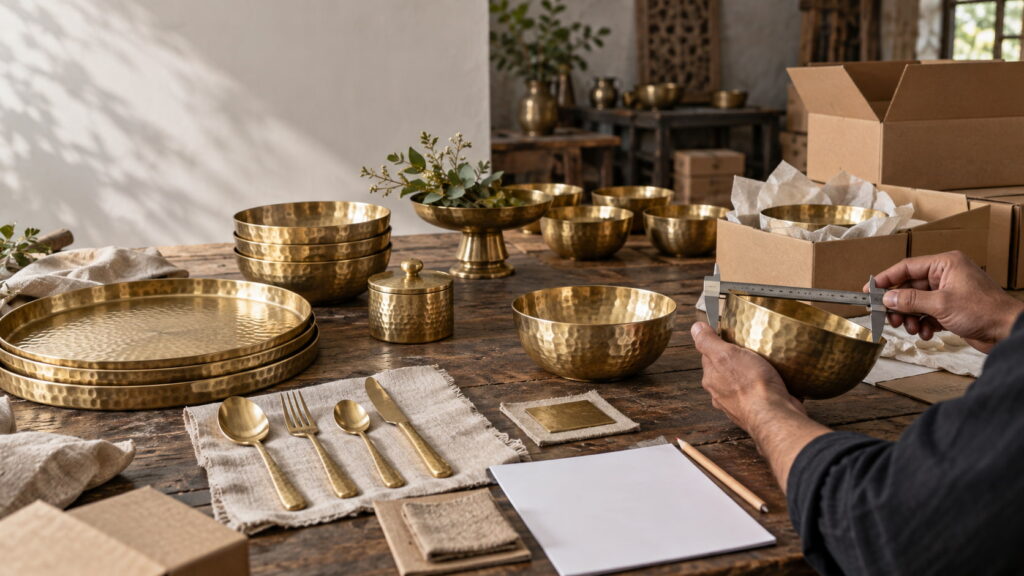
- Edge treatment
- Surface quality
- Function
- Branding
- Packaging
Compare products together.
A tray that looks perfect individually may seem too bright beside the bowls.
A small bowl might feel unexpectedly heavy when combined into a four-piece set.
A finish may photograph differently from how it looks under store lighting.
The purpose of sampling is not merely to confirm that the supplier can make the object.
It is to confirm that the product belongs in your collection.
Step 11: Create a Sample Approval System
Once the final sample is approved, do not lose track of what was approved.
Give it a reference.
For example:
Approved Master Sample — BR-BOWL-01 — Version 3
Record:
- Date
- Dimensions
- Weight
- Material
- Finish
- Logo
- Packaging
- Notes
Photograph it.
Keep the physical sample where practical.
Future production and reorders can then be checked against something real.
Step 12: Decide How the Brand Appears on the Product
Private label does not require putting a large logo on the visible surface.
Branding can be subtle.
Options may include:
- Underside engraving
- Discreet stamping
- Monogram
- Small logo
- Product code
- Branded packaging only
The right approach depends on the brand.
A quiet-luxury product may benefit from restrained marking.
A corporate gift might require a more visible logo.
Ask:
Does the customer need to see the brand during use, or simply know who made the product when they turn it over?
That difference matters.
Step 13: Test Engraving Before Bulk Production
Do not send the logo artwork and assume the first production result will be correct.
Approve:
- Size
- Position
- Depth
- Orientation
- Spacing
- Method
Test it on the actual metal and finish.
A mark that looks clear on bright polished brass may disappear against a heavily hammered antique surface.
The engraving process can also interact with coatings or finishes.
Approve a physical example.
Step 14: Treat Packaging as Part of the Product
For a private-label retail brand, the customer’s experience begins before the metal object is touched.
Packaging may need to:
- Protect the finish
- Communicate the brand
- Explain the material
- Provide care information
- Identify the SKU
- Carry a barcode
- State origin information where required
- Survive fulfilment
- Fit retail shelving
Good packaging does not necessarily mean excessive packaging.
A well-sized box with intelligently designed internal protection may be better than a large presentation package full of empty space.
Step 15: Design Retail Packaging Around Freight Too
Retail packaging affects international shipping.
Suppose a bowl occupies:
20 × 20 × 10 cm
without a presentation box.
If decorative packaging increases that to:
28 × 28 × 16 cm
the increase in shipping volume can become significant across hundreds of units.
Before approving packaging, calculate:
- Product dimensions
- Retail box dimensions
- Units per master carton
- Master-carton dimensions
- Gross weight
- Total shipment volume
Beautiful packaging that destroys the landed-cost model is not successful packaging.
Step 16: Build a Clear Labelling System
Depending on your market and retail operation, packaging may need fields such as:
- Brand
- Product name
- SKU
- Barcode
- Material
- Care instructions
- Country of origin
- Importer details where required
- Warnings or use information where applicable
- Quantity
- Capacity or dimensions where relevant
Do not copy the label format from an unrelated product.
Requirements depend on the product and destination.
For example, U.S. Customs and Border Protection notes that imported goods generally need country-of-origin marking for the ultimate purchaser, subject to specific exceptions.
Confirm applicable rules before printing an entire production run.
Step 17: Decide Who Owns the Barcode
Private-label brands should establish their product-identification structure early.
GS1 states that the brand owner—the organisation that owns the specifications of the trade item—is normally responsible for assigning the GTIN, regardless of where or by whom the product was manufactured.
GS1 specifically notes that the brand owner can be a retailer that has the product manufactured in another country and sells it under its own brand.
That means the retailer should generally think through:
- Product hierarchy
- SKUs
- Variants
- Pack sizes
- GTINs/barcodes
- Master-carton identification
before packaging artwork is final.
Do not make barcode management the printer’s problem at the last minute.
Step 18: Decide How Many SKUs the First Collection Really Needs
More SKUs do not automatically make a stronger launch.
Imagine two possible first ranges.
Collection A
24 products
4 finishes
3 sizes
Many small quantities
Collection B
8 strong products
1–2 finishes
Concentrated quantity
Collection B may be easier to:
- Sample
- Quality control
- Photograph
- Merchandise
- Stock
- Reorder
- Understand commercially
There is no universal ideal number.
But complexity should earn its place.
A variant should exist because it improves the collection, not because the supplier can make it.
Step 19: Understand MOQ by SKU, Not Just by Order
Ask exactly how minimum order quantities work.
MOQ can apply:
- Per design
- Per size
- Per finish
- Per colour
- Per engraving
- Per packaging version
- Per total purchase order
For example:
500 total units
might sound workable.
But if the supplier requires:
100 units per SKU
then a 12-SKU collection needs a different buying plan.
Clarify this before finalising the assortment.
Step 20: Separate Product MOQ From Packaging MOQ
Packaging suppliers can have their own minimums.
Your metalware supplier may accept:
100 units of a product
while a custom printed box supplier requires:
500 or 1,000 boxes.
This can create unused packaging if the product changes.
Ask separately about:
- Product MOQ
- Printed-box MOQ
- Tissue MOQ
- Care-card MOQ
- Sticker MOQ
- Custom insert MOQ
Sometimes a simpler packaging system works better during the first launch.
Step 21: Understand Development and Tooling Costs
A fully custom product may involve costs beyond the finished-unit price.
Potential development charges can include:
- Drawing
- Prototype
- Pattern
- Tool
- Die
- Mould
- Jig
- Engraving plate
- Packaging die-line
- Sample courier
Ask which are:
- One-time charges
- Repeat charges
- Refundable against production
- Owned by supplier
- Owned by buyer
- Stored for future orders
For proprietary products, tooling ownership should be documented rather than assumed.
Step 22: Clarify Design Ownership and Exclusivity
If you pay to develop a custom design, establish what happens afterwards.
Questions to discuss include:
- Who owns the design?
- Who owns the tooling?
- Can the supplier sell the same design to another customer?
- Is geographic exclusivity required?
- Is channel exclusivity required?
- For how long?
- What happens if the buyer stops ordering?
- Can minor variants be sold elsewhere?
These are commercial-contract questions rather than assumptions.
For highly differentiated collections, address them before paying for development.
Step 23: Protect Brand Assets
If you provide:
- Logo files
- Packaging
- Proprietary drawings
- Custom patterns
- Product names
- Photography
- Confidential launch information
be clear about permitted use.
Depending on the relationship and project value, businesses may use contractual confidentiality and intellectual-property provisions.
The appropriate legal structure depends on the jurisdictions involved, so obtain professional advice where necessary.
The practical point is simple:
your logo artwork and proprietary product designs should not become casual factory assets.
Step 24: Know the Intended Product Use
A centrepiece and a soup bowl may look similar.
Their regulatory and construction requirements can be very different.
Classify every SKU.
For example:
Decorative Only
Not intended for food contact.
Serving
Used in a food-service context.
Direct Food Contact
Food touches the metal or lining.
Drinkware
Liquid-contact vessel.
Cutlery
Used directly during eating or serving.
This classification should happen before the packaging copy is written.
Step 25: Check Destination-Market Food-Contact Rules
For products intended to contact food, compliance needs to be market specific.
European Union
The European Commission defines kitchenware and tableware used with food as Food Contact Materials.
Products placed on the EU market must comply with the general framework under Regulation (EC) No 1935/2004, as well as Good Manufacturing Practice requirements and any relevant material-specific or national legislation. The framework requires that materials should not transfer constituents into food at levels harmful to health or cause unacceptable changes to the food.
This is important for private-label retailers because the item will appear under your brand to the consumer.
Do not build compliance around a vague supplier statement such as:
“Food safe.”
Ask:
- Which product?
- Which alloy?
- Which lining?
- Which coating?
- Which food type?
- Which market?
- Which test or supporting evidence?
Step 26: Remember That Importers and Brand Owners Have Responsibilities Too
A supplier is not the only party in the chain.
For example, UK product-safety guidance states that businesses placing products on the market need to be able to demonstrate compliance with relevant regulations, provide adequate consumer information and maintain appropriate traceability.
The exact obligations vary by jurisdiction and product category.
The important principle for a private-label retailer is:
Do not outsource all compliance thinking to the workshop.
The brand and importer also need to understand the market where the product will be sold.
Step 27: Do Not Treat One Test Report as Universal
A test report may apply to:
- One product
- One alloy
- One coating
- One lining
- One production method
- One sample
- One regulatory requirement
Changing the construction can change what evidence is relevant.
For example, replacing a lining or changing a coating may mean that an older test report no longer represents the final product.
Whenever compliance is material, ensure documentation corresponds to the actual production specification.
Step 28: Create Care Instructions Before Packaging Goes to Print
Care instructions should be based on the actual product.
Consider questions such as:
- Hand wash only?
- Dishwasher suitable?
- Dry immediately?
- Avoid abrasive cleaners?
- Avoid acidic food?
- Do not soak?
- Polish or do not polish?
- Natural patina expected?
- Is a coating present?
Good care information does two things.
It helps the customer preserve the product.
And it reduces avoidable dissatisfaction caused by normal material behaviour.
Step 29: Explain Patina Rather Than Hiding It
If your private-label collection uses real brass, copper or bronze, surface change can be part of the material story.
A customer who expects permanent showroom brightness may consider natural darkening a defect.
A customer who understands patina may value it.
So explain it.
Product descriptions might distinguish between:
- Natural ageing
- Applied antique finish
- Lacquered finish
- Polished finish
Material honesty builds better expectations.
Step 30: Develop the Retail Price From Landed Cost
Do not start with the supplier’s unit cost and simply multiply it by a standard markup.
First understand landed cost.
Depending on the transaction, that may involve:
**Factory price
- product development
- branding
- retail packaging
- master-carton packaging
- inspection
- inland logistics
- export handling
- international freight
- insurance
- import duty
- customs fees
- taxes where applicable
- warehouse delivery**
Then consider the commercial costs of selling:
- Fulfilment
- Marketplace commission
- Store margin
- Promotions
- Returns
- Damage allowance
- Customer acquisition
- Photography
A product with a compelling factory price can still fail financially if its packaging makes it expensive to ship.
Step 31: Agree the International Trade Term
For international B2B orders, buyer and supplier should clearly agree which party handles different parts of delivery.
The International Chamber of Commerce’s Incoterms® 2020 provides 11 standard trade terms used to clarify delivery responsibilities, costs and risk between seller and buyer.
The selected rule should be accompanied by the appropriate named place or port.
Do not leave the agreement as:
“Freight extra.”
That does not adequately explain responsibility.
Step 32: Check the Exporter’s Readiness
For commercial export from India, DGFT states that an Importer-Exporter Code (IEC) is mandatory for import/export activity unless a specific exemption applies.
DGFT also identifies core documents for exports of goods from India including:
- Applicable transport document
- Commercial invoice-cum-packing list
- Shipping bill or bill of export
Additional documentation can be required for specific goods or regulatory conditions.
A private-label buyer does not need to manage Indian export customs personally.
But it is reasonable to establish who is responsible for these processes.
Step 33: Confirm Whether a Certificate of Origin Is Needed
A Certificate of Origin should not simply be added to every checklist as though every order uses one in exactly the same way.
India’s DGFT operates systems covering both preferential and non-preferential Certificates of Origin, including documentation connected with trade agreements.
Whether one is needed and in what form depends on the transaction, destination and applicable trade arrangement.
Confirm with the responsible customs or trade professional for the actual shipment.
Step 34: Design Packaging for Export, Not Just Retail Shelves
Private-label products often need two layers of packaging.
Retail Packaging
What the customer sees.
It may contain:
- Product
- Brand story
- Care instructions
- Barcode
- Protective insert
Transport Packaging
What gets the product there safely.
It may require:
- Surface protection
- Separators
- Inner cartons
- Master cartons
- Edge protection
- Moisture protection where relevant
- Shipping marks
A beautiful retail box still needs to survive international freight.
Step 35: Consider Nesting During Product Design
Metalware can occupy substantial shipping volume.
Bowls and trays designed to nest efficiently can improve:
- Carton utilisation
- Warehousing
- Freight efficiency
- Retail storage
But nesting should not allow metal surfaces to rub against each other.
Consider:
- Separators
- Sleeves
- Tissue
- Paper pads
- Protective inserts
An efficient product design considers the carton as well as the table.
Step 36: Create a Quality-Control Standard Before Production
Do not decide what quality means after 1,000 units have been manufactured.
A QC standard can include:
Material
- Correct base metal
- Correct construction
Dimensions
- Diameter
- Height
- Capacity
- Critical functional measurements
Weight
Where relevant.
Finish
- Approved colour range
- Surface texture
- Polish
- Patina
Construction
- Stable base
- Secure handles
- Smooth edges
- Appropriate joins
Branding
- Correct logo
- Correct position
- Correct orientation
Packaging
- Correct box
- Correct insert
- Correct barcode
- Correct SKU
- Correct quantity
The standard should focus on what actually matters to the product.
Step 37: Use an Approved Master Sample
The most practical quality reference is often the approved physical sample.
It answers questions that words struggle to define.
What does:
“medium antique brass”
really mean?
The sample shows it.
What is an acceptable hammer pattern?
The sample helps demonstrate it.
What is the correct visual weight?
Again, the sample.
Written specification + approved sample is stronger than either one alone.
Step 38: Inspect Production Before Everything Is Packed
For significant orders, quality checks may be useful at more than one stage.
Early Production
Does production match the approved sample?
During Production
Are dimensions, finish and construction staying consistent?
Pre-Shipment
Are quantity, branding and packaging correct?
The complexity of inspection should reflect the size and risk of the order.
The principle is simply to identify systematic errors before they affect every unit.
Step 39: Check Packaging Artwork Against the Product
One surprisingly common source of error is packaging that describes a product incorrectly.
Before printing, compare artwork with the final production specification.
Check:
- Material
- Product name
- Dimensions
- Capacity
- Quantity
- Care
- Origin
- Barcode
- Warnings
- Imported-by information where required
If the product changed during development, the packaging must change too.
Step 40: Conduct a Pre-Production Meeting
Before bulk manufacturing begins, confirm the final version of:
- Product
- Material
- Dimensions
- Finish
- Logo
- Packaging
- Quantity
- Price
- Timeline
- Quality criteria
- Shipping term
Remove obsolete sample versions and old artwork from active use.
Production teams should not have to guess which email attachment was final.
Step 41: Build the Purchase Order Around the Specification
The purchase order should connect the commercial order to the approved product.
Include relevant details such as:
| Area | Detail |
| SKU | Brand product code |
| Product | Final approved product |
| Material | Agreed construction |
| Finish | Approved finish reference |
| Quantity | Final units |
| Packaging | Approved version |
| Unit Price | Agreed amount |
| Currency | Transaction currency |
| Branding | Approved logo method |
| QC | Agreed standard |
| Delivery | Agreed timeline |
| Trade Term | Agreed Incoterm and named place |
Keep important agreements in formal documentation rather than scattered across messages.
Step 42: Leave Time for Product Development
A private-label launch timetable should include more than factory production.
A realistic sequence may look like:
Collection brief
→ supplier discussion
→ product selection
→ sample development
→ sample shipment
→ internal review
→ revision
→ final sample
→ compliance work
→ packaging development
→ barcode assignment
→ purchase order
→ material procurement
→ production
→ inspection
→ packing
→ export
→ international freight
→ customs
→ warehouse intake
→ photography / merchandising
→ launch
If the collection must launch before Christmas, a hotel opening or a retail season, work backwards from the required warehouse date.
Not from the date you hope production will begin.
Step 43: Avoid Launching Every Possible Variation
One bowl in:
- Small
- Medium
- Large
- Brass
- Copper
- Bronze
- Antique
- Polished
already creates numerous potential SKUs.
Multiply that across ten products and the assortment becomes difficult quickly.
Start with the variants that have a clear commercial reason to exist.
Customer data can guide expansion later.
Step 44: Plan the Photography During Development
Private-label products ultimately have to sell.
Consider photography while selecting finishes.
Ask:
- Will the finish photograph accurately?
- Will all products look coherent together?
- Are product dimensions visually obvious?
- Do reflective surfaces require specialist lighting?
- Does the packaging belong in the same visual world?
Metal can be challenging to photograph because it reflects everything around it.
A consistent finish strategy helps enormously.
Step 45: Create Product Content From Verified Specifications
Once the final product is approved, write product descriptions from the actual specification.
Useful information includes:
- Material
- Finish
- Dimensions
- Weight
- Capacity
- Construction
- Intended use
- Care
- Handmade variation
- Origin
Avoid unsupported phrases such as:
“100% food safe everywhere.”
or:
“will never tarnish.”
Specific information builds more trust than broad promises.
Step 46: Educate Customer-Service Teams
If your range uses handcrafted metal, customer-service teams should understand basic material behaviour.
They may receive questions such as:
Why is my brass getting darker?
Why doesn’t my bowl look exactly like the website photo?
Can I put this in the dishwasher?
Is the hammering supposed to vary?
Can I use lemon juice in this vessel?
Accurate customer support reduces unnecessary returns.
Step 47: Plan for Reorders Before Launch
A successful private-label collection should be designed for its second order.
Before the first shipment leaves, establish:
- Product codes
- Approved sample references
- Finish references
- Packaging files
- Logo artwork
- Carton configuration
- Reorder quantities
- Tooling records
- Testing records
- Production notes
When a product sells out, you should not have to ask:
“Does anyone remember which antique finish we used?”
Step 48: Expect Some Batch Variation in Hand-Finished Work
A handmade finish produced months later may not be microscopically identical to the first production batch.
That does not mean consistency is impossible.
It means consistency should be defined intelligently.
The objective might be:
same finish family and agreed appearance range
rather than:
every molecule the identical RGB value.
Keep master samples.
For important finishes, compare new production against them.
Step 49: Review the First Shipment Before Scaling
Your first commercial order produces valuable information.
Review:
Product
Did customers like the material, weight and finish?
Quality
What defects or inconsistencies appeared?
Packaging
Did products arrive safely?
Logistics
Was carton configuration efficient?
Sales
Which SKUs actually moved?
Returns
What caused them?
Care
Which customer questions repeated?
Reorders
Which products deserve more inventory?
The second order should be smarter than the first.
Step 50: Build a Supplier Relationship Around Information
A successful long-term private-label relationship is not built only on negotiation.
It depends on reliable information flowing both ways.
The brand should communicate:
- Forecasts
- Launch dates
- Product changes
- Quality feedback
- Packaging updates
The supplier should communicate:
- Production realities
- Material changes
- Finish limitations
- Timeline risks
- Quality issues
A supplier who tells you that a proposed detail will not work is often more useful than one who agrees to everything and fails during production.
Private Label Metalware Buyer Checklist
Before committing to a custom tableware collection, confirm:
Brand
- Target customer defined
- Target retail pricing considered
- Collection aesthetic defined
- Product categories selected
- Core and hero SKUs identified
Product
- Base metal confirmed
- Solid / plated construction confirmed
- Dimensions approved
- Weight reviewed
- Finish approved
- Intended use defined
- Lining/coating documented where relevant
Samples
- Physical samples reviewed
- Function tested
- Finish reviewed under realistic light
- Final master sample approved
- Sample reference recorded
Branding
- Logo placement approved
- Engraving/stamping sample approved
- Product naming complete
- SKU system created
- Barcode responsibility established
Packaging
- Retail packaging approved
- Product protected adequately
- Care instructions verified
- Country-of-origin requirement checked
- Master-carton configuration confirmed
- Packaging MOQ understood
Compliance
- Destination market confirmed
- Food-contact use identified
- Relevant product requirements reviewed
- Testing requirements established
- Packaging claims checked
- Importer obligations reviewed
Commercial
- Product MOQ confirmed
- MOQ per variant understood
- Development costs identified
- Tooling ownership documented
- Unit price confirmed
- Currency confirmed
- Payment terms agreed
Production
- Final specification issued
- QC criteria agreed
- Production timeline confirmed
- Inspection stage agreed
- Defect resolution understood
Shipping
- Incoterm agreed
- Named place/port stated
- Carton dimensions confirmed
- Gross weight confirmed
- Required export documents identified
- Final warehouse date planned
Reorders
- Master samples retained
- Reorder MOQ understood
- Packaging artwork archived
- Finish references archived
- Tooling records retained
- Replenishment process discussed
Common Private-Label Metalware Mistakes
Choosing Products Before Defining the Brand
You end up with an assortment rather than a collection.
Better: write the collection brief first.
Launching Too Many SKUs
Money and quantities become fragmented across products.
Better: concentrate the opening range around stronger items.
Assuming Private Label Means Logo Only
Brand differentiation remains weak.
Better: consider finish, dimensions, sets, packaging and collection architecture.
Copying Competitors
The range begins life without a distinctive point of view.
Better: use references to communicate principles, then create your own design.
Approving Metal Colour on a Screen
Metal changes dramatically with lighting and photography.
Better: approve physical samples for critical finishes.
Ignoring Packaging MOQ
You may be left with hundreds of obsolete boxes.
Better: separate packaging requirements from product MOQ.
Printing Packaging Before Final Product Approval
Specifications change but the box does not.
Better: freeze the product first.
Treating Compliance as the Supplier’s Problem
Your brand may still carry market-facing and importer responsibilities.
Better: identify destination requirements early.
Forgetting Reorders
The first batch looks good, but nobody recorded the specification.
Better: build the documentation system before launch.
Expecting Handmade Products to Be Identical
Minor craft variation becomes an unnecessary dispute.
Better: establish an acceptable range.
Accepting Every Variation Because It Is Handmade
Functional problems go unchecked.
Better: separate craft character from defects.
Why Build a Private-Label Metalware Collection in India?
For international brands, India brings together a large handicraft export sector and deep traditions of working metals by hand.
EPCH’s latest published data places total Indian handicrafts exports at ₹33,168.48 crore for 2025–26, with art metalware alone at ₹4,349.83 crore. The United States accounted for ₹1,625.47 crore of the reported art-metalware exports, while Germany, the U.K., UAE, Netherlands and other markets also represented significant trade.
But scale is only one part of the opportunity.
The more interesting possibility for design-led brands is combining repeatable commercial specifications with techniques that still leave evidence of the maker.
A surface can be controlled without being sterile.
A collection can be repeatable without looking machine anonymous.
That balance is where private-label handcrafted metalware becomes interesting.
Developing a Private-Label Collection With Lume Loam
Lume Loam’s current range is made around handcrafted metal objects for the table and home, including brass, copper and bronze pieces.
Its published policies confirm that its products are made to order and reference bespoke, personalised, custom-size and custom-finish pieces.
That establishes some degree of custom-product capability publicly.
However, a retail policy is not the same as a complete private-label manufacturing agreement.
For a B2B project, buyers should therefore confirm the exact capabilities for their proposed collection, including:
- Available product categories
- Materials
- Custom dimensions
- Custom finishes
- Branding
- Packaging
- MOQ
- Sampling
- Tooling
- Food-contact requirements
- Testing
- Production capacity
- Export terms
- Lead time
- Reorder quantities
- Design exclusivity
Do not assume these from the retail website.
Discuss them against the actual project.
A useful first private-label enquiry would include:
Brand / retailer:
Who you are.
Market:
Where the collection will be sold.
Customer:
Who it is designed for.
Products:
What you want to develop.
Material:
Brass, copper, bronze or another direction.
Finish:
Reference images or samples.
Quantity:
Initial estimate per SKU.
Target price:
Where appropriate.
Branding:
Logo or packaging requirements.
Compliance:
Intended use and destination.
Timeline:
Required warehouse or launch date.
The aim is not simply to ask:
“Can you private label this?”
It is to provide enough information to determine whether the product, process and commercial structure make sense for both sides.
From Indian Workshop to Your Brand
Private label works best when the supplier does not disappear from the process simply because the consumer sees another name on the box.
Someone still shaped the metal.
Someone still hammered the surface.
Someone still polished the edge.
Someone still checked the piece before it entered the carton.
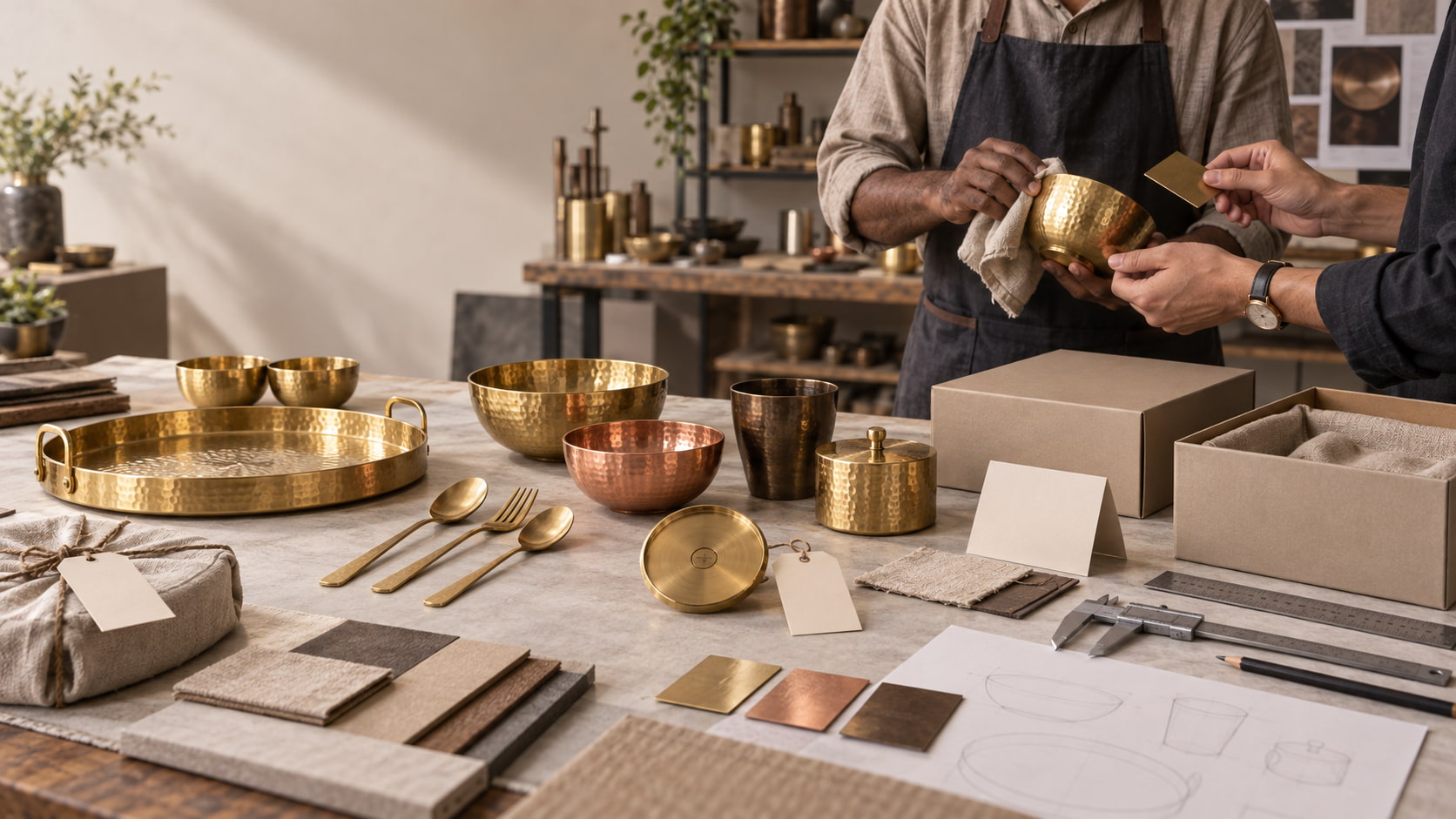
The retailer’s job is to turn those physical processes into a coherent commercial product.
That requires more than branding.
It requires:
**a clear brief
- the right material
- an approved sample
- accurate specifications
- considered packaging
- appropriate compliance
- controlled production
- reliable quality checks
- documented reorders.**
Get those pieces right and private-label sourcing becomes something more useful than placing a logo on somebody else’s product.
It becomes product development.
And that is how a retailer can build a metalware collection in India that belongs recognisably to its own brand while still preserving the character of the hand that made it.
Frequently Asked Questions
What is private-label metalware?
Private-label metalware is manufactured by a supplier but sold under another company’s brand. The retailer or brand may control packaging, product naming and marketing, while the level of physical product customisation can range from minimal changes to completely custom development.
Can a retailer create custom metal tableware in India?
Yes. India has an established handicrafts and art-metalware export industry. EPCH reports ₹4,349.83 crore of art-metalware exports in 2025–26. Individual suppliers differ significantly in materials, processes, MOQ and custom-development capability, so these should be verified project by project.
What is the difference between white label and private label tableware?
White-label products are typically relatively standard products that can be branded by multiple businesses. Private-label manufacturing is a broader model in which products are manufactured for sale under the retailer’s brand and can include standard, modified or fully custom designs.
Do I need to design every product from scratch?
No. A private-label collection can combine existing products, modified designs and entirely new pieces. Starting from selected existing forms can reduce development complexity, while custom finishes, dimensions, packaging and hero products provide differentiation.
What should I send a private-label metalware supplier?
Send a clear brief including product categories, intended use, preferred materials, finishes, dimensions, approximate quantities, target market, branding requirements, packaging, reference images and required delivery date.
Should I order samples before bulk production?
Yes. Samples let you evaluate dimensions, weight, balance, finish, function, branding and packaging before committing to production quantities. The final approved sample should ideally become the reference for quality control and reorders.
Who should create barcodes for private-label products?
GS1 states that the brand owner is normally responsible for assigning the GTIN, regardless of where or by whom the product is manufactured. A retailer that has products made under its own brand can therefore be the responsible brand owner for GTIN allocation.
What MOQ is required for private-label metalware?
There is no universal MOQ. It can vary by design, production method, material, finish, customisation, packaging and supplier. Ask whether the MOQ applies per SKU, finish, size or total order.
Can my logo be engraved on metal tableware?
Depending on the supplier and product, branding may potentially be engraved, stamped or applied through other methods. Approve a physical branding sample because size, depth and visibility can differ according to the material and finish.
How should I choose packaging for a private-label collection?
Packaging should protect the finished metal surface, support the brand, meet applicable labelling requirements and use space efficiently. Review both the customer-facing retail package and the outer master carton used for transport.
Who owns a custom tableware design?
That depends on the commercial agreement. Design rights, tooling ownership and exclusivity should be documented before development rather than assumed.
Does private-label tableware need country-of-origin marking?
Requirements depend on the destination market. As one example, U.S. Customs and Border Protection states that imported articles generally require country-of-origin marking for the ultimate purchaser, subject to statutory exceptions.
What export documents are used when metalware is shipped from India?
DGFT identifies a transport document, commercial invoice-cum-packing list and shipping bill or bill of export among the mandatory core documents for exports of goods from India. Additional documentation may apply according to the product, destination and regulatory conditions.
Are private-label brass and copper products automatically safe for food use?
No. Food-contact suitability depends on the exact material, alloy, lining, coating, intended use and destination-market rules. In the EU, food-contact tableware must comply with the general framework of Regulation (EC) No 1935/2004 alongside other applicable requirements.
Can handmade private-label products vary between units?
Yes. Hand forming, hammering and finishing can create small differences in texture, grain, patina or dimensions. The buyer and supplier should agree which variations are acceptable and which functional characteristics must remain within defined tolerances.
How do I make a private-label metalware collection feel unique?
Start with a defined design language rather than simply adding your logo. Use consistent material choices, finishes, shapes, proportions, surface treatments, packaging and a small number of distinctive hero products to create a recognisable collection.