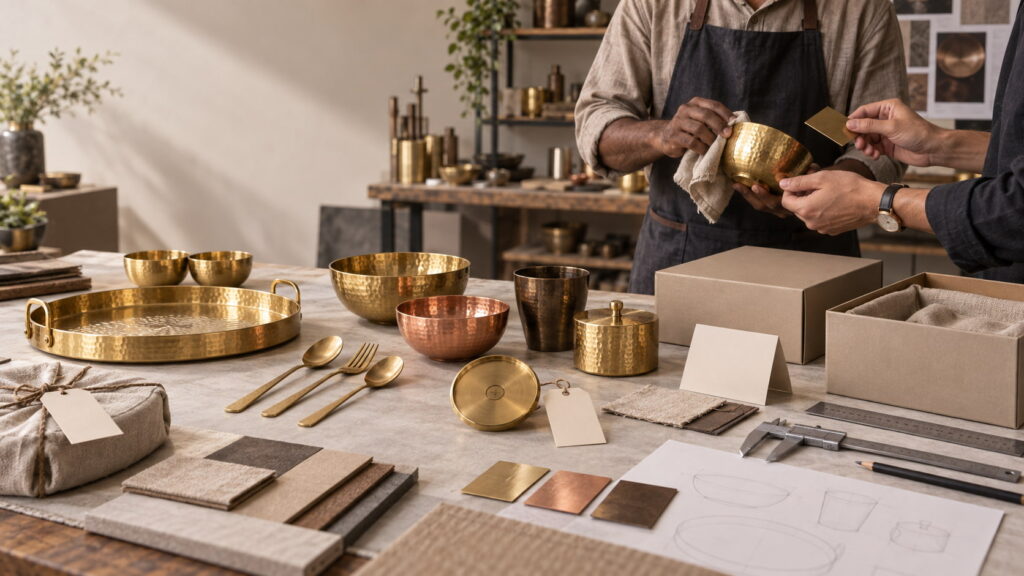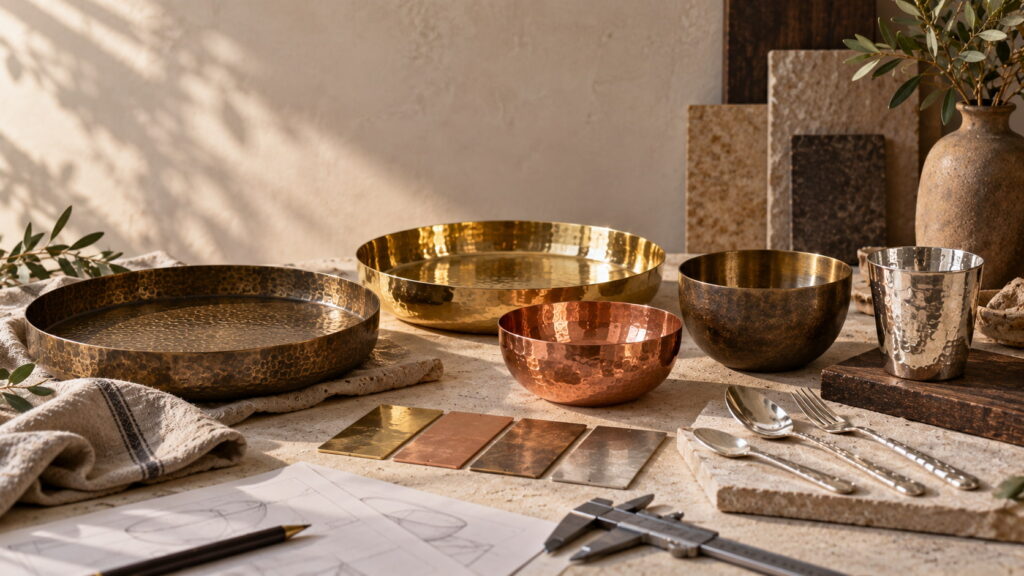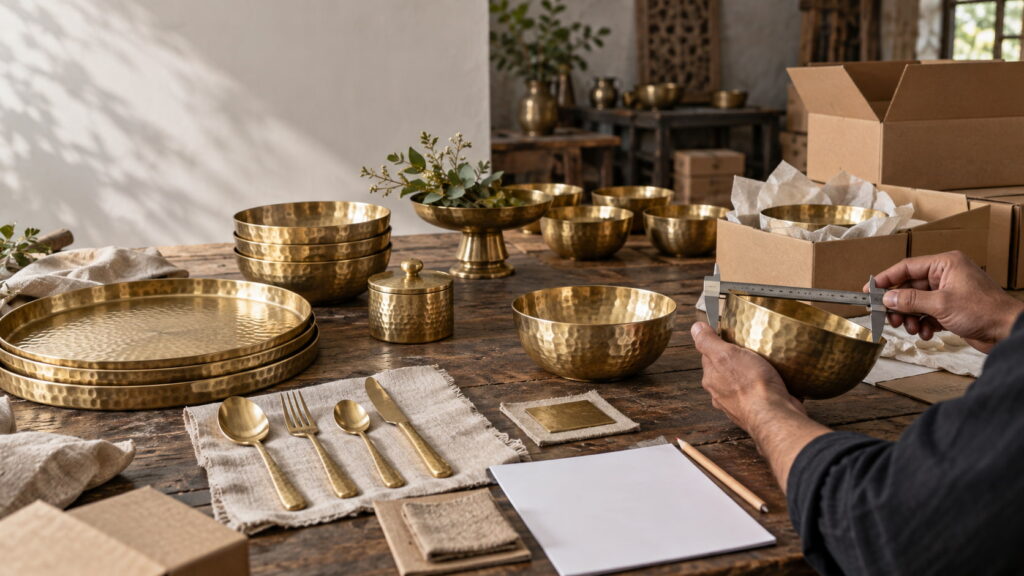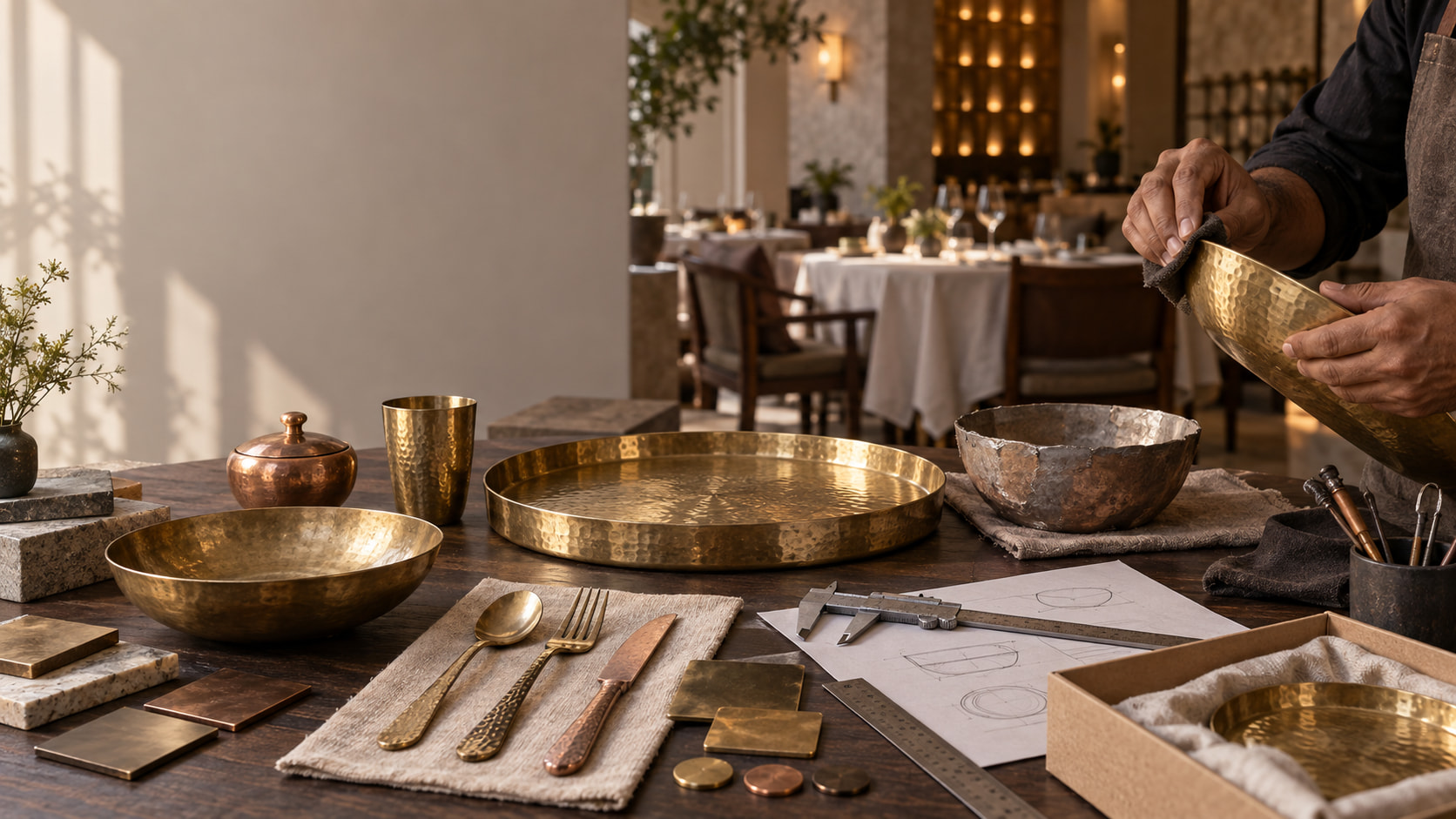

 Hospitality & Projects
A bowl designed for a photograph only has to look good once.
A bowl designed for a restaurant may need to be carried, stacked, served, cleared, washed, dried and returned to the table hundreds of times.
That difference changes the design brief.
For hotels, restaurants, resorts and hospitality groups, custom metal tableware is not simply about choosing an attractive tray, bowl or serving vessel and ordering it in quantity. The product has to work within the way the property actually operates.
It needs the right proportions.
The right material.
A finish that suits the interior.
A weight staff can handle.
A form that works with the food being served.
Packaging that protects the surface.
And, where food contact is involved, construction that is appropriate for both the intended use and the destination market.
For international hospitality buyers sourcing from India, there is already a substantial manufacturing and craft ecosystem to work with. India’s Export Promotion Council for Handicrafts reports ₹4,349.83 crore of art-metalware exports in 2025–26, with major export destinations including the United States, Germany, the United Kingdom, the UAE and the Netherlands.
But successful custom development still begins long before production.
It begins with the brief.
What Is Custom Metal Tableware?
Custom metal tableware is tableware developed or adapted around the requirements of a particular buyer rather than purchased solely as an unchanged standard product.
That customisation can happen at different levels.
A hotel may take an existing serving bowl and request a different finish.
A restaurant may need a standard tray produced in dimensions that fit a particular table.
A hospitality group may want its logo engraved in a consistent position.
A chef may need an entirely new serving vessel designed around a signature dish.
Customisation can therefore include:
- Dimensions
- Shape
- Capacity
- Material
- Surface texture
- Finish
- Colour or patina
- Handles
- Feet or bases
- Engraving
- Branding
- Packaging
- Sets or combinations of products
The more the product changes from an existing design, the more important prototyping and approval become.
Why Hospitality Tableware Needs a Different Design Process
Hospitality products live differently from objects used occasionally at home.
A restaurant serving piece might move through the same cycle several times in one evening:
Storage → kitchen → plating → table → clearing → washing → drying → storage
A hotel banquet operation may need hundreds of pieces prepared together.
A bar may need serving objects that can be picked up quickly in low light.
Room service may require trays that fit specific trolleys.
A buffet may need vessels that work at a particular height and proportion.
That is why custom hospitality tableware should be considered as part of the operating environment, not simply the interior design.
Before discussing shapes and finishes, ask:
Where will the object be used?
That question usually leads to better design decisions.
Stage 1: Build a Clear Design Brief
A good custom tableware project starts with information.
The brief does not have to be a polished technical document. But it should give the supplier enough context to understand what the product needs to do.
Include:
Property Type
Is this for a:
- Fine-dining restaurant?
- Boutique hotel?
- Luxury resort?
- Café?
- Bar?
- Banquet operation?
- Casual restaurant?
- Room-service programme?
The environment affects both design and durability expectations.
Intended Use
Be specific.
“Serving bowl” is broad.
“Individual bread service for a 60-cover restaurant” is much more useful.
Similarly:
“Tray for hotel” tells the supplier very little.
“Welcome-drink tray carried by one member of staff, six glasses per service” provides something that can actually be designed around.
Quantity
Provide approximate quantities even during early development.
Production decisions for 20 pieces may differ from those for 2,000.
Destination
The destination country matters because food-contact, labelling, import and documentation requirements can differ between markets.
Delivery Requirement
Work backwards from the opening, refurbishment or launch date.
Do not assume production is the only stage that requires time.
Custom development can involve:
Brief → design → prototype → review → revision → approval → production → finishing → inspection → packing → export → customs → final delivery
Stage 2: Start With Function Before Decoration
Hospitality buyers often begin with reference images.
That is useful.
But the final object needs more than the right visual language.
Imagine a custom brass bread basket.
Before discussing decorative details, answer:
- How many pieces of bread should it hold?
- Is it carried individually or stacked?
- Does it need a liner?
- How much table space can it occupy?
- How will guests pick it up?
- How will staff clear it?
- Where will it be stored?
- How will it be cleaned?
- Should several baskets nest together?
Those answers may affect the diameter, depth, weight, base, handles and rim.
In hospitality, the form should follow both service and setting.
Stage 3: Choose the Right Material
Metal choice affects appearance, weight, maintenance and use.
Depending on the product and project, buyers may consider materials such as:
- Brass
- Copper
- Bronze
- Stainless steel
- Aluminium
- Tin
- Plated metals
Each creates a different visual character.
Brass
Brass typically provides a warm yellow-gold appearance and works particularly well when a hospitality concept needs warmth without relying on highly reflective gold plating.
It can move between contemporary and heritage-led settings depending on the shape and finish.
Copper
Copper has a recognisable reddish warmth and can create a stronger visual accent.
It can be particularly effective for signature serving pieces or when the interior palette includes warm woods, leather, stone or terracotta tones.
Bronze
Bronze generally gives a deeper and more subdued metal character.
It can work particularly well where the table needs warmth without a bright surface.
Do Not Choose Metal by Colour Alone
The exact alloy, construction, thickness, coating, lining and finish all matter.
A supplier should know whether the product is:
- Solid metal
- Plated
- Coated
- Lined
- Unlined
- Lacquered
- Naturally finished
For commercial food-service applications, these details are more important than the material name on its own.
Stage 4: Decide How the Surface Should Feel
Finish changes the entire personality of metal tableware.
Consider the difference between:
Mirror-polished brass
and
hand-hammered antique brass.
The base metal may be similar, but visually the objects can belong to completely different restaurants.
Common design directions can include:
- Polished
- Satin
- Brushed
- Hammered
- Antiqued
- Patinated
- Textured
- Matte
- Plated
- Combination finishes
The finish should relate to both the brand and real-world use.
A highly reflective surface can look impressive when freshly styled but may show fingerprints differently from a more textured surface.
A deeply textured finish can add craft character, but the design still needs to remain practical to handle and maintain.
There is no universal “best hotel finish”.
There is only the finish that works with the product, service routine and design language.
Stage 5: Develop the Dimensions Around the Service
A few millimetres can matter more than expected.
Consider a custom restaurant plate or bowl.
The diameter affects:
- Food presentation
- Table spacing
- Storage
- Dishwasher racks
- Shelving
- Staff handling
- Carton size
- Shipping volume
Depth affects:
- Portion presentation
- Sauce containment
- Stackability
- Storage height
Weight affects:
- Perceived quality
- Carrying
- Clearing
- Staff fatigue
- Freight cost
This is why hospitality buyers should ideally provide more than a mood board.
Provide dimensions.
And when possible, explain why those dimensions matter.
Stage 6: Create a Prototype or Pre-Production Sample
One of the most valuable steps in custom metalware development is also one of the easiest to rush.
The sample.
A drawing can show proportions.
A rendering can show appearance.
Neither tells you exactly how the object feels in your hand.
A physical sample allows the hotel, restaurant or designer to assess:
- Scale
- Weight
- Balance
- Finish
- Texture
- Capacity
- Edge treatment
- Handle comfort
- Stability
- Stackability
- Branding
- Cleaning practicality
Test the Sample Where It Will Actually Be Used
If possible, put it into service.
Ask a chef to plate with it.
Ask a server to carry it.
Place it on the restaurant table.
Stack ten together.
Try storing it.
See how it looks under the property’s actual lighting.
Try the intended cleaning procedure.
Photography can hide operational problems.
Service usually reveals them.
Stage 7: Approve a Reference Sample
Once the right version has been developed, identify the approved reference.
That sample becomes the benchmark for production.
Record:
- Dimensions
- Weight where relevant
- Material
- Finish
- Surface texture
- Branding position
- Colour reference
- Packaging
- Other critical details
Photographs are useful, but written specifications should accompany them.
A phrase such as:
“Same antique brass as sample”
can become ambiguous months later.
A documented specification makes reorders much easier.
Stage 8: Define Acceptable Handmade Variation
Handcrafted metal should not necessarily look as though every piece came from the same mould and polishing machine.
Hammer marks may move.
Surface texture can differ slightly.
Hand-applied finishes may contain subtle variation.
Lume Loam’s public terms, for example, state that its hand-hammered, cast, sculpted and hand-finished pieces may show variations in hammer patterns, surface grain, colour, finish sheen and minor dimensions as inherent characteristics of craft.
This can be an important part of the visual appeal.
But “handmade” should not become a reason for uncontrolled production.
A hospitality buyer can still define requirements such as:
- Diameter tolerance
- Height tolerance
- Stable base
- Smooth edges
- Consistent capacity
- Logo position
- Overall finish family
- Packing method
A useful principle is:
Accept variation in character. Control variation in function.
Stage 9: Check Food-Contact Requirements Early
For tableware intended to hold or serve food, compliance should not be discussed only when production is complete.
Different markets have different requirements.
European Union
The European Commission classifies kitchenware and tableware that come into contact with food as Food Contact Materials.
Food-contact materials placed on the EU market must comply with the general framework established by Regulation (EC) No 1935/2004. The framework requires, among other things, that materials should not transfer constituents to food at levels that could endanger human health or cause unacceptable changes to food composition, taste or odour.
Specific and national requirements can also apply depending on the material.
United States
In the United States, the exact product and its intended use also matter.
The FDA Food Code, for example, says copper and copper alloys such as brass generally may not contact foods below pH 6—including examples such as vinegar, fruit juice and wine—subject to specified exceptions.
The FDA also makes clear that the Food Code is a model used by food-control jurisdictions for retail and food-service regulation rather than a universal product certification.
Ask the Specific Question
Do not rely on:
“Is this metal food safe?”
Instead ask:
“Is this exact product, with this alloy, lining, finish and construction, suitable and compliant for the way we intend to use it in our market?”
That produces a much more useful answer.
Stage 10: Think About Cleaning Before Production
A hotel restaurant may care for an object very differently from a private customer.
The product could encounter:
- Frequent washing
- Commercial detergents
- Warm water
- Drying racks
- Repeated handling
- Stacking
- Cloth polishing
- Long periods in storage
Before approving the finish, establish the recommended care routine.
Ask:
- Hand wash only?
- Dishwasher compatible?
- Immediate drying required?
- Can abrasive pads be used?
- Does it require polishing?
- Will polishing alter the finish?
- Is there a coating that can wear?
- What happens if the surface develops patina?
This information can affect whether the product is operationally suitable.
A beautiful finish that requires a level of maintenance the property cannot realistically provide is probably the wrong finish.
Stage 11: Make Branding Subtle
Custom hotel tableware does not always need a large logo.
Often, the most successful branding is quieter.
Options might include:
- Small engraved logo
- Initials
- Property monogram
- Discreet underside mark
- Custom motif
- Branded packaging
- Bespoke surface pattern
Consider where the object will be photographed.
A prominent logo may work well on a room-service tray but feel distracting on a fine-dining presentation.
Ask whether the brand needs to be seen immediately or simply recognised on closer inspection.
Those are different design goals.
Stage 12: Plan for Stackability and Storage
A product can be beautiful on the table and difficult everywhere else.
Before bulk production, ask:
How many can be stacked?
How much shelf height will they require?
Can finished surfaces rub against each other?
Does stacking make the pieces unstable?
Will a separator be required?
This can change the design itself.
A slight alteration in wall angle can improve nesting.
A different handle position may allow trays to stack more efficiently.
A protruding decorative element may make bulk storage unnecessarily difficult.
For hospitality products, the back-of-house experience matters almost as much as the dining-room experience.
Stage 13: Confirm the Commercial Order
Once the design is approved, the project moves from development into manufacturing.
The purchase order should clearly identify what has actually been agreed.
Depending on the project, this may include:
| Requirement | What to Confirm |
| Product | Exact product / SKU / approved design |
| Material | Agreed metal or alloy |
| Dimensions | Final approved measurements |
| Finish | Approved reference finish |
| Quantity | Total pieces per item |
| Branding | Logo, engraving or marking |
| Packaging | Individual and master-carton method |
| Price | Unit and total price |
| Currency | Agreed transaction currency |
| Payment | Agreed commercial terms |
| Production | Approved production window |
| Inspection | Agreed QC procedure |
| Delivery | Destination and required timing |
| Trade terms | Agreed Incoterm if international |
Do not leave important decisions inside a long email chain.
Put the final version into the commercial documentation.
Stage 14: Move Into Bulk Production
Once a sample is approved, production should follow that reference.
For handcrafted metalware, production can include several stages depending on the design:
Material preparation → forming → shaping → joining → surface work → hammering or texturing → polishing → finishing → lining or coating where specified → branding → inspection → packing
Not every object follows the same route.
Some may be formed from sheet.
Others may involve casting.
Some designs may require several specialised processes.
The buyer does not need to control every workshop operation.
But the supplier and buyer should agree what the finished output needs to achieve.
Stage 15: Inspect During Production, Not Just After It
If a large order contains a mistake that could have been identified early, inspecting only the final packed cartons is too late.
Depending on order size and complexity, quality checks can happen at several points.
Material Check
Confirm that the specified material is being used.
First Production Check
Review early production against the approved sample.
Finish Check
Assess whether the overall appearance remains within the approved finish range.
Functional Check
Check stability, dimensions, handles, capacity, stacking or any product-specific requirement.
Final Check
Confirm quantity, condition, branding and packaging before dispatch.
Not every project needs a complicated inspection system.
But every project benefits from deciding what “approved” means before production begins.
Stage 16: Build a Useful Quality Checklist
For custom hotel and restaurant tableware, the QC checklist might include:
Appearance
- Finish matches approved reference
- No unintended deep scratches
- No unacceptable dents
- Surface treatment complete
- Branding correctly positioned
Construction
- Stable on a flat surface
- Handles secure
- Joints finished appropriately
- Edges smooth
- No unintended sharp points
Dimensions
- Diameter within agreed range
- Height within agreed range
- Capacity correct where relevant
- Weight within agreed range where specified
Function
- Stacks correctly
- Handles comfortably
- Fits intended service equipment
- Holds intended portion or object
Packing
- Surfaces separated
- Adequate protection provided
- Correct quantity per carton
- Cartons properly identified
The checklist should reflect the actual product.
A cocktail tray and soup bowl do not require identical checks.
Stage 17: Treat Packaging as Part of Hospitality Procurement
Custom metal tableware can travel a long way before it reaches the restaurant table.
During that journey, pieces can:
- Rub
- Scratch
- Dent
- Shift
- Tarnish
- Press against each other
The packaging needs to protect the finish without wasting unnecessary volume.
Discuss:
- Individual wrapping
- Surface separators
- Inner cartons
- Master cartons
- Corner protection
- Moisture considerations
- Nesting
- Carton dimensions
- Gross weight
- Units per carton
- Pallet requirements where relevant
For an international hospitality project, packaging affects both damage risk and freight cost.
A product that nests efficiently may take dramatically less shipment space than one that cannot.
Good packaging therefore begins during product development, not five minutes before dispatch.
Stage 18: Plan International Shipping Clearly
For global hospitality projects, buyer and supplier should agree who is responsible for which part of the journey.
The International Chamber of Commerce’s Incoterms® 2020 rules provide 11 standard trade terms used to clarify tasks, costs and risks between buyers and sellers.
Whichever term is used, specify the relevant named place or port.
Shipping arrangements can affect:
- Freight booking
- Insurance
- Export clearance
- Main carriage
- Import clearance
- Duties
- Local delivery
- Risk transfer
These details matter particularly when a hotel opening has a fixed deadline.
Stage 19: Confirm Export Documentation
For exports of goods from India, DGFT identifies core documentation including:
- Bill of lading, airway bill or other applicable transport receipt
- Commercial invoice-cum-packing list
- Shipping bill or bill of export
Additional documents can be required for particular goods, destination markets or regulatory conditions.
Depending on the shipment, this may also involve documentation such as a certificate of origin or product-specific evidence where applicable.
Do not use a generic export checklist for every country.
Confirm the requirements for the exact product and destination.
Stage 20: Plan for Replacement Pieces From the Beginning
This is one of the biggest differences between residential and hospitality buying.
Things happen in service.
Products can be:
- Dropped
- Lost
- Damaged
- Removed from circulation
- Needed at a new property
If the original order contains exactly the minimum number of pieces required to operate, normal attrition can create a problem later.
Ask:
- Can this design be reordered?
- Will the finish remain available?
- Can smaller replenishment orders be produced?
- Should spare units be included in the first order?
- Will the approved specification remain on record?
There is no universal spare percentage that works for every hospitality property.
The appropriate quantity depends on product type, breakage or loss risk, storage and operating model.
The important point is to discuss replenishment before the first order is finished.
Stage 21: Design for Reorders, Not Just Opening Day
A custom collection becomes more valuable when it can continue working after launch.
Record:
- Product codes
- Drawings
- Dimensions
- Material
- Finish
- Approved sample
- Logo artwork
- Packaging
- Quantity history
This avoids beginning from zero every time the restaurant needs another batch.
For multi-property hospitality groups, this becomes even more important.
A properly documented product can become part of a repeatable brand standard rather than a one-off purchase.
Existing Design or Fully Custom: Which Is Better?
Not every hospitality project needs a product designed from scratch.
There are three useful routes.
1. Existing Product
Choose an existing product without substantial changes.
Useful when:
The design already fits the operational requirement and the project needs simpler sourcing.
2. Existing Product With Customisation
Start from an existing design and modify:
- Finish
- Dimensions
- Engraving
- Packaging
- Selected details
Useful when:
The buyer wants differentiation without undertaking full product development.
3. Fully Custom Product
Develop an object around a specific brief.
Useful when:
The service concept or brand requires something that existing products cannot provide.
None of these routes is automatically better.
The right one depends on what the restaurant actually needs.
A Practical Custom Tableware Development Timeline
Rather than asking only:
“How long does production take?”
Break the project into stages:
1. Brief
Buyer provides project, use, quantities, destination and timing.
2. Design Discussion
Form, material, dimensions, finish and branding are developed.
3. Sampling
Prototype or reference sample is produced.
4. Review
Buyer tests and provides feedback.
5. Revision
Changes are made where necessary.
6. Final Approval
Sample and written specification are approved.
7. Bulk Production
Order enters manufacturing.
8. Quality Control
Products are checked against the agreed requirements.
9. Packing
Approved pieces are protected and packed.
10. Dispatch
Export and freight arrangements begin.
This gives hospitality teams a far more realistic project schedule than treating manufacturing as one single block of time.
What Should Be in a Hotel or Restaurant Tableware Brief?
Before contacting a supplier, prepare:
Property Information
- Hotel / restaurant name
- Location
- Concept
- Opening or launch date
Product Information
- Product category
- Intended use
- Approximate dimensions
- Quantity
- Preferred material
- Preferred finish
Design Information
- Mood board
- Interior images
- Reference products
- Colour palette
- Logo files
Operational Information
- Cleaning method
- Storage limitations
- Stacking requirement
- Portion or capacity requirement
- Frequency of service
Commercial Information
- Target quantity
- Destination
- Required delivery
- Packaging requirements
- Budget range where appropriate
A detailed brief saves time on both sides.
Questions to Ask Before Approving Bulk Production
Before giving final approval, ask:
Product
- Is the final material confirmed?
- Are dimensions confirmed?
- Is the finish approved?
- Is capacity confirmed where relevant?
- Has the sample been tested in service?
Food Contact
- What is the exact construction?
- Is there a lining or coating?
- What uses is the product intended for?
- What destination-market requirements apply?
- Is testing or documentation required?
Operations
- Can products stack safely?
- How should they be washed?
- How should they be stored?
- Will the finish change through regular use?
Commercial
- Is final quantity agreed?
- Is the unit price final?
- Are tooling or development charges identified?
- Is the production window agreed?
- Is the delivery term clear?
Quality
- What variation is acceptable?
- What will be inspected?
- Which sample is the reference?
- How will issues be handled?
Reorders
- Can the design be reproduced?
- How will the finish reference be retained?
- Are replenishment quantities possible?
Common Mistakes When Ordering Custom Hospitality Tableware
Designing Only for Appearance
The product looks beautiful but is awkward for servers, difficult to wash or impossible to stack.
Better: test the prototype during real service.
Approving Colour From a Screen
Metal finishes change dramatically with lighting and screen settings.
Better: approve a physical sample when finish matching is important.
Forgetting the Back of House
A bowl may look perfect on a dining table but occupy twice as much storage space as expected.
Better: assess storage and stacking during sampling.
Leaving Food-Contact Questions Until the End
Compliance issues discovered after manufacturing can become expensive.
Better: identify destination and intended use at the brief stage.
Treating Handmade Variation as a Defect
Minor variation can be an inherent result of hand forming and hand finishing.
Better: establish acceptable variation beforehand.
Accepting “Handmade” as an Excuse for Everything
Functional dimensions, stability and workmanship can still be controlled.
Better: separate craft variation from quality requirements.
Forgetting About Reorders
A successful restaurant may need replacements sooner than expected.
Better: document the specification and discuss replenishment before the first production run.
Why Source Handcrafted Metal Tableware From India?
India combines a long metalworking tradition with an established handicrafts export industry.
EPCH’s current figures show that Indian handicraft exports reached ₹33,168.48 crore in 2025–26, with art metalware accounting for ₹4,349.83 crore.
For hospitality buyers, the attraction is not simply the availability of metal products.
It is the opportunity to work with techniques such as:
- Hand forming
- Hammering
- Casting
- Engraving
- Surface finishing
- Traditional metal craft
These processes can give a hotel or restaurant collection a material character that is difficult to reproduce through anonymous mass production.
But craft works best commercially when it is combined with a clear specification.
The goal should not be:
handmade instead of consistent.
It should be:
handmade and fit for purpose.
Custom Hospitality Tableware With Lume Loam
Lume Loam works with handcrafted metal objects for the table and home across materials including brass, copper and bronze.
Its public policies currently describe products as made to order and also reference bespoke, personalised, custom-size and custom-finish pieces. Exact commercial capabilities, quantities, development requirements and lead times for a hospitality project should therefore be confirmed directly for the individual brief rather than assumed from a retail product page.
For a hotel or restaurant enquiry, a useful first message should include:
- Property or restaurant name
- Location
- Product required
- Intended use
- Approximate dimensions
- Material preference
- Finish direction
- Approximate quantity
- Destination country
- Required delivery date
- Branding requirements
- Reference images or mood board
You do not need to arrive with every technical detail solved.
That is what the development conversation is for.
But the clearer the context, the easier it becomes to make an object that belongs to the property rather than simply placing a logo on something that already exists.
From One Brief to Hundreds of Pieces
Custom tableware works best when design and production are treated as one continuous process.
The brief tells the maker what the object needs to do.
The prototype tests the idea.
The sample establishes the standard.
The specification protects the details.
Quality control keeps production aligned.
Packaging protects the work.
And good documentation makes the next order easier than the first.
For a hotel or restaurant, that process matters because the object will eventually disappear into daily service.
Guests may never know how many decisions went into the tray holding their drink or the bowl arriving with dinner.
They should not need to.
They should simply feel that it belongs there.
Frequently Asked Questions
Can hotels and restaurants order custom metal tableware from India?
Yes. India has an established handicrafts and art-metalware export sector. The exact customisation options, MOQ, development cost, production capacity and delivery schedule depend on the individual supplier and project. EPCH reports ₹4,349.83 crore of Indian art-metalware exports during 2025–26.
What can be customised in metal tableware?
Depending on manufacturing capability, customisation may involve dimensions, shape, capacity, material, finish, surface texture, engraving, branding, packaging or a completely new design. Buyers should confirm available options before assuming that every aspect can be changed.
Should restaurants approve a sample before bulk production?
For custom products, a physical sample or prototype is strongly advisable. It allows the team to evaluate scale, weight, balance, finish, food presentation, handling, storage and cleaning before committing to a larger order.
Which metal is best for restaurant tableware?
There is no universally best metal. Brass, copper, bronze, stainless steel and other metals offer different visual and operational characteristics. Selection should consider design, intended use, maintenance, exact construction and applicable food-contact requirements.
Can brass or copper tableware be used with food?
Suitability depends on the exact alloy, lining or coating, intended food, contact conditions and destination regulations. For example, the FDA Food Code restricts copper and copper-alloy surfaces such as brass from contact with foods below pH 6 in covered food-service contexts, subject to stated exceptions.
Are handmade hospitality products identical?
Not necessarily. Hand hammering and finishing can create small differences in texture, grain, sheen or colour. Commercial buyers should agree which variations represent natural craft character and which functional dimensions or defects are unacceptable.
How should a hotel calculate its custom tableware quantity?
Consider the number of covers, number of services, washing turnaround, storage, simultaneous events, replacement needs and how frequently each item is used. There is no single percentage or formula suitable for every property.
What information should I send when requesting custom hotel tableware?
At minimum, provide the product type, intended use, dimensions or capacity, preferred material and finish, approximate quantity, destination, branding requirements and required delivery date. Reference photographs and interior mood boards can also help.
How early should a restaurant begin a custom tableware project?
Begin early enough to allow for design, sampling, revisions, final approval, manufacturing, quality control, packing and transport. International projects should also allow time for export and import procedures. Avoid calculating the schedule from manufacturing time alone.
Can custom tableware be reordered later?
Potentially, but this should be discussed before the first bulk order. Keep approved samples, drawings, dimensions, finish references, artwork and product codes so that future production has a clear reference.