
 Materials & Finishes
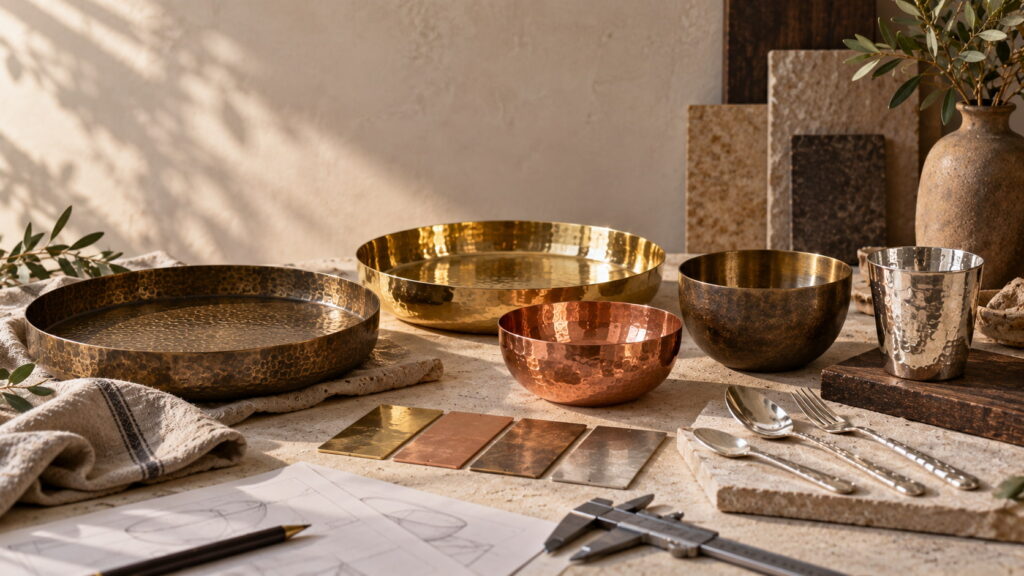
Brass, copper and bronze can sit on the same table and still create three very different impressions.
Copper brings warmth and a distinctive reddish tone. Brass has a brighter yellow-gold character. Bronze tends towards deeper, quieter brown-gold tones that can feel more grounded and traditional.
But choosing between them is not simply a question of colour.
For a retailer, interior designer, hospitality buyer or sourcing team, the right material depends on the product’s purpose, surface finish, intended food contact, maintenance expectations, collection direction and the market in which it will eventually be sold.
Understanding those differences before developing a collection can make material selection much easier.
This guide compares brass vs copper vs bronze tableware, explains where each material can work particularly well and outlines the questions buyers should ask before placing a trade order.
Brass, Copper and Bronze: What Is the Difference?
The first distinction is straightforward:
Copper is a metal. Brass and bronze are families of copper alloys.
Brass is principally associated with copper and zinc alloys, while many traditional bronzes are copper-tin alloys. The Copper Development Association maintains separate commercial alloy families for coppers, brasses and bronzes, with individual compositions varying considerably within each family.
That last point matters for buyers.
“Brass” is not one exact formula.
Neither is “bronze.”
Different alloys can contain different proportions of their primary metals and may contain additional elements depending on the required manufacturing or performance characteristics.
So when sourcing metal tableware, specifying only “brass” or “bronze” may not be enough for applications where exact composition matters.
Brass Tableware
What Is Brass?
Brass is a copper-based alloy in which zinc is a major alloying element.
Different copper-to-zinc ratios produce different types of brass. Copper Development Association data, for example, lists commercial brasses with substantially different copper and zinc percentages rather than one universal composition.
For tableware and décor buyers, however, its most immediately recognisable characteristic is visual.
Brass usually brings a warm yellow-to-golden metal tone.
That colour makes it particularly useful when a collection needs richness without looking highly polished or overly formal.
What Does Brass Look Like?
Depending on the alloy and finish, brass can move from bright yellow-gold to warmer, muted or aged tones.
It can be:
- Highly polished
- Satin finished
- Brushed
- Hammered
- Antiqued
- Darkened
- Textured
- Left to develop surface character over time
This versatility is one reason brass can work across very different design directions.
A polished brass serving tray can feel formal.
The same form with a hammered or aged finish can feel much more tactile and relaxed.
Where Does Brass Work Well in a Collection?
Brass can be considered for products such as:
- Serving trays
- Bowls
- Cutlery
- Serving utensils
- Containers
- Napkin accessories
- Candle holders
- Centrepieces
- Decorative tabletop objects
- Bar accessories
- Display pieces
The exact intended use should always be checked against the construction and finish of the individual product.
Lume Loam’s current range, for example, includes handcrafted brass pieces such as its Brass Art Deco Tray alongside other metal tableware and decorative objects.
Why Buyers Choose Brass
From a collection-design perspective, brass has one significant advantage:
It has a strong visual identity without limiting you to one aesthetic.
Brass can sit comfortably in:
Contemporary collections
Use cleaner forms, restrained geometry and brushed finishes.
Heritage-inspired collections
Use traditional shapes, detailed surfaces and warmer patinas.
Hospitality settings
Use repeated serving pieces or tabletop accents to establish a consistent material language.
Gifting collections
The golden character naturally gives an object a sense of occasion.
Mixed-material collections
Brass pairs visually with materials such as wood, stone, glass and textiles without needing every object on the table to be metallic.
Copper Tableware
What Is Copper?
Copper is the base metal from which brass and many bronze alloys are derived.
Commercial copper grades can be very high in copper content. Copper Development Association reference data, for example, lists C11000 copper at a nominal minimum of 99% copper, while specific grades and compositions vary according to specification.
Its natural colour separates it immediately from brass and bronze.
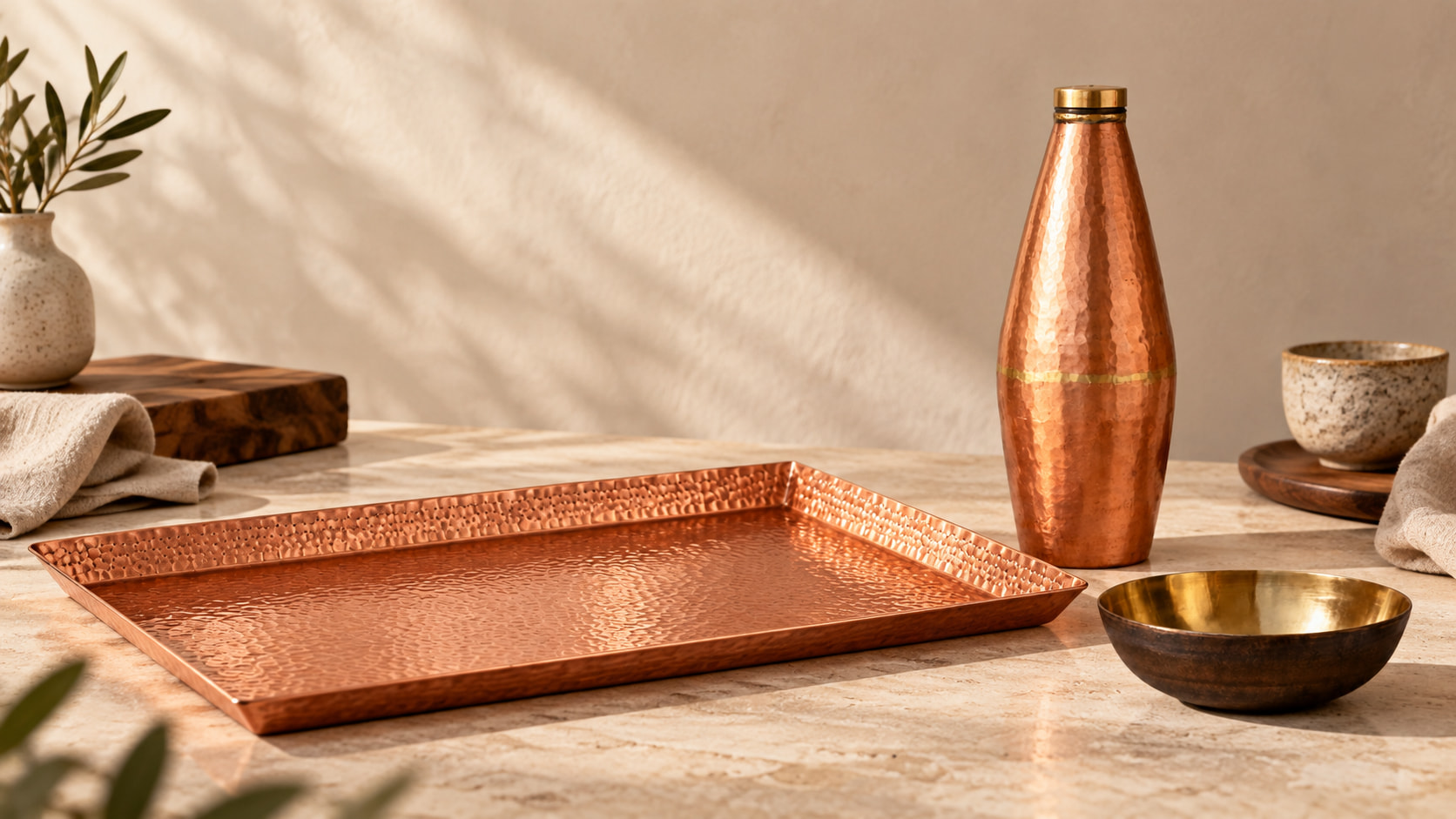
Copper tends towards red, orange and warm reddish-brown tones.
That makes it one of the most visually recognisable metals on a table.
Why Copper Feels Different
Copper does not merely add metallic shine.
It adds colour.
Placed next to white ceramics, dark stone, natural linen or wood, copper creates a pronounced warm contrast.
That can make it particularly effective when a collection needs a hero material rather than a neutral supporting one.
Lume Loam’s present assortment includes copper products such as the Copper Square Bowl Set, demonstrating how the material can be used in smaller tabletop forms as well as larger pieces.
Copper Changes With Time
Untreated copper surfaces do not necessarily retain their original appearance indefinitely.
Copper and copper alloys can change colour through oxidation and environmental exposure, developing progressively darker or patinated surfaces. Copper Development Association references describe copper changing from its original reddish appearance through brown tones and, under suitable exterior environmental conditions, eventually towards grey-green patination.
For tableware, the exact change depends heavily on:
- Finish
- Coating
- Handling
- Moisture
- Cleaning
- Acidity
- Storage conditions
- Frequency of use
This is important commercially.
Some buyers love the evolving surface.
Others expect every item to remain close to its original colour.
Those expectations should be discussed before approving a collection.
Where Does Copper Work Well?
Depending on construction and intended use, copper can be considered for:
- Bowls
- Trays
- Cups
- Tumblers
- Bottles
- Serving vessels
- Barware
- Decorative objects
- Centrepieces
- Accent pieces
Copper is particularly useful when you want a material to become part of the visual story rather than disappear into the background.
Bronze Tableware
What Is Bronze?
Bronze is another family of copper-based alloys.
Traditional tin bronzes combine copper with tin, although modern commercial bronze classifications include several alloy families. Copper Development Association classifications include copper-tin bronzes as well as other bronze groups, which is why buyers should not assume that every product described as “bronze” has an identical composition.
In Indian table traditions, copper-tin alloys are also closely associated with Kansa tableware.
The result is a material character that generally sits visually between the brighter yellow of many brasses and the reddish colour of copper.
What Does Bronze Look Like?
Bronze commonly has a deeper, more subdued metal tone.
Depending on composition and surface treatment, it can appear:
- Golden brown
- Brown
- Dark gold
- Warm grey-brown
- Aged or patinated
- Softly polished
Compared with highly polished brass, bronze often feels visually quieter.
Compared with copper, it usually carries less red.
That makes it useful for collections where the buyer wants warmth without making the metal the brightest element on the table.
Lume Loam currently carries bronze tableware including a Bronze Cup, alongside its wider collection of handcrafted metal objects.
Brass vs Copper vs Bronze: Quick Comparison
| Feature | Brass | Copper | Bronze |
| Material family | Copper alloy, typically with zinc | Base metal | Copper alloy; traditional bronzes commonly use tin |
| Typical visual tone | Yellow-gold | Reddish copper | Deeper brown-gold |
| Visual impact | Warm and luminous | Strong and distinctive | Subdued and grounded |
| Works well for | Broad tableware and décor collections | Feature pieces and warm accents | Heritage-led and quieter metal collections |
| Surface character | Can be polished, brushed, hammered or antiqued | Can develop noticeable surface change | Often suits deeper aged finishes |
| Collection mood | Versatile | Expressive | Understated |
| Important buyer question | Which alloy and finish? | Is the surface lined/coated and how should it be used? | Which bronze composition is being supplied? |
These are design-level distinctions rather than universal technical specifications.
The final behaviour of any product depends on its exact alloy, construction, lining, coating, finish and intended use.
Which Metal Looks Most Luxurious?
There is no objective winner.
Luxury is created as much by proportion, finish, weight, workmanship and restraint as by the metal itself.
A badly finished polished brass object does not become premium simply because it is gold-toned.
A quietly hammered bronze bowl can feel considerably more considered.
A copper piece with a beautiful hand-worked surface can become the visual centre of an entire table.
Instead of asking:
“Which metal looks most expensive?”
A better question is:
“Which metal supports the character of this collection?”
Choose Brass When You Want Versatility
Of the three, brass may be the easiest material to build a broad visual collection around.
Its gold family of tones works across:
- Retail tableware
- Hospitality
- Decorative accessories
- Gifting
- Serving pieces
- Contemporary interiors
- Traditional interiors
It can be bright without being flashy and aged without looking unfinished.
For buyers developing several related SKUs, this gives considerable room to vary shape and texture while keeping the material language consistent.
Brass can be particularly effective when:
- You want a warm gold appearance.
- Your range includes both functional and decorative pieces.
- You plan to combine metal with wood, glass or stone.
- You want multiple finish directions within the same material family.
- The collection needs to move easily between contemporary and traditional settings.
Choose Copper When Colour Matters
Copper is more visually assertive.
Its reddish-orange warmth creates a noticeable contrast with most neutral tabletop materials.
This can make it ideal for:
- Feature serving pieces
- Statement bowls
- Drinkware
- Barware
- Accent objects
- Smaller capsule collections
- Collections built around warm natural colours
A full table made entirely from copper can make a strong statement.
But copper also works extremely well in smaller quantities.
One bowl.
One tray.
A pair of cups.
A serving vessel.
For a buyer developing a large collection, copper does not necessarily have to be the dominant material.
It can be the note that gives the range its warmth.
Choose Bronze When You Want Quiet Depth
Bronze generally creates a more restrained visual impression.
The deeper tone can work particularly well in collections influenced by:
- Traditional Indian tableware
- Heritage objects
- Earthy interiors
- Natural materials
- Dark woods
- Stone
- Handmade ceramics
- Linen
For a collection intended to feel settled rather than shiny, bronze deserves serious consideration.
It has presence without necessarily becoming the first thing the eye notices.
Do You Have to Choose Only One?
No.
In fact, some of the most interesting collections are built around controlled contrast.
You might use:
- Brass for trays and serving utensils
- Copper for accent bowls
- Bronze for cups or smaller tabletop pieces
Or choose one primary material and introduce another only occasionally.
The important word is controlled.
Three metals used randomly can make a range feel disconnected.
Three metals used deliberately can make it feel layered.
How to Mix Brass, Copper and Bronze in One Collection
If you want to use more than one metal, decide what creates continuity.
1. Repeat the Finish Language
For example:
Hammered brass + hammered copper + hammered bronze
The metals differ, but the surface treatment ties them together.
2. Repeat Shapes
Use a consistent rim profile, handle geometry or bowl silhouette across different metals.
3. Control the Colour Ratio
One metal can dominate while the others act as accents.
For example:
70% brass
20% bronze
10% copper
This is a design approach, not a fixed formula.
4. Use Material by Function
Instead of changing metal randomly, assign each one a role.
For example:
Serving pieces: brass
Drinkware: bronze
Accent pieces: copper
The collection then feels intentional.
What About Patina?
Patina is one of the characteristics that makes copper-based metals interesting.
But it is also one of the most misunderstood.
Copper and many copper alloys naturally respond to their environment. Their surfaces can darken or change through oxidation and exposure. The Copper Development Association notes that naturally formed patinas can also serve as protective surface films in architectural copper applications.
For tableware buyers, however, “patina” can mean several different things:
Natural patina
Surface change produced over time through use and exposure.
Applied patina
A finish intentionally created during production.
Antique finish
A controlled treatment intended to make a new piece appear aged or deeper in colour.
These should not automatically be treated as interchangeable.
Ask your supplier:
- Is the colour natural or applied?
- Is there a protective coating?
- Will the appearance change with handling?
- What cleaning method is recommended?
- Can the finish be restored?
- How much variation should be expected between pieces?
For a wholesale range, those answers are commercially important.
Handmade Metalware Will Not Be Visually Identical
Metal choice is only one part of the final appearance.
Hand finishing also matters.
Lume Loam describes many of its products as handcrafted, hammered, sculpted or hand-finished, with small variations in colour, texture, patina, dimensions or weight being natural characteristics of handmade production.
For buyers, that means two principles need to coexist:
Accept the character of handwork.
But also:
Define the limits of acceptable variation.
If colour consistency is critical to a large hospitality installation, that needs to be discussed.
If every hammered mark being slightly different is desirable, that should also be understood.
The objective is not industrial sameness.
It is controlled craft.
Brass vs Copper vs Bronze for Food Contact
This is where buyers need to be more careful.
You should never decide whether a tableware product is appropriate for food contact based only on the name of the metal.
Food-contact suitability can depend on:
- Exact alloy composition
- Interior lining
- Surface coating
- Manufacturing process
- Type of food
- Acidity
- Temperature
- Contact duration
- Destination-market regulations
For example, the U.S. FDA Food Code states that copper and copper alloys such as brass generally should not contact foods below pH 6, such as vinegar, fruit juice or wine, subject to specified exceptions. The FDA explains that acidic foods can cause copper to leach from copper or copper-alloy surfaces.
The FDA Food Code is a model used by regulatory jurisdictions, not a universal global product certification.
That distinction is important.
A product intended for serving dry snacks in one market and a vessel intended to hold acidic drinks in another may need completely different assessment.
So for trade buying, avoid the overly broad question:
“Is brass food safe?”
Ask instead:
“Is this specific product, in this exact construction and finish, suitable and compliant for its intended food-contact use in my destination market?”
That is the question that matters.
What Should International Buyers Ask a Supplier?
Before selecting brass, copper or bronze for a commercial collection, ask:
About the Material
- What is the base metal?
- Is it solid metal or plated?
- What alloy is being used?
- Are material specifications available where needed?
- Is the product lined?
- Is the product coated or lacquered?
About the Finish
- Is it polished, brushed, hammered, antiqued or patinated?
- Is the finish sealed?
- Will it naturally change with use?
- What colour variation should be expected?
About Use
- Is the piece decorative or functional?
- Is it intended for food contact?
- Are there restrictions on the type of food or drink?
- What cleaning method is recommended?
About Production
- What variation is normal in handmade production?
- Can a reference sample be approved?
- What dimensional tolerances can be maintained?
- Can the same finish be repeated on reorders?
About Compliance
- Has the intended destination market been identified?
- Does testing need to be arranged?
- What supporting documentation is available?
- Who is responsible for confirming buyer-specific compliance requirements?
These questions are more useful than choosing a material from photographs alone.
Choosing the Right Metal for Retail
Retail buyers need to consider both the object and the customer.
Ask:
Will customers understand the material?
If a surface is intended to change naturally, the care card or product description should explain that.
How will the product look under store lighting?
Polished metal can appear very different under bright retail lighting than in natural daylight.
Will the collection photograph well together?
Colour balance matters for ecommerce and campaign photography.
Can replacements and reorders remain reasonably consistent?
This becomes more important when products remain in the assortment for several seasons.
The best metal is therefore not just the one that looks strongest in a sample.
It is the one that continues to work across the entire retail journey.
Choosing Metal Tableware for Hotels and Restaurants
Hospitality buyers face a different set of questions.
The object may be used repeatedly rather than occasionally.
Consider:
- Frequency of handling
- Cleaning procedures
- Storage and stacking
- Surface marking
- Replacement availability
- Food-contact requirements
- Weight for staff
- Table concept
- Lighting
- Reorder consistency
A dramatic copper bowl might be ideal for one signature presentation.
A broader brass collection may make more sense when many related serving objects are required.
A bronze piece may suit a dining concept where the table needs warmth without high reflectivity.
Material selection should therefore happen alongside operational planning, not separately from it.
Choosing Metalware for Gifting
Gifting creates another use case.
Here, presentation can matter almost as much as everyday functionality.
Brass works naturally when the brief asks for a warm, celebratory feel.
Copper creates stronger colour and can make even a relatively simple form visually memorable.
Bronze may suit a more heritage-led or understated gift.
But buyers should also consider:
- Personalisation
- Engraving
- Packaging
- Product weight
- Shipping
- Quantity
- Repeatability
- Recipient care instructions
The material is part of the gift, but it is not the entire gifting experience.
Maintenance Should Be Considered Before Purchase
A collection that looks beautiful only when professionally styled is not always a practical collection.
Ask how the products should actually be maintained.
Depending on the metal and finish, instructions may cover:
- Hand washing
- Immediate drying
- Avoiding abrasive cleaning
- Avoiding certain acidic substances
- Periodic polishing
- Allowing a natural patina to develop
- Protecting applied surface finishes
Do not create your own generic maintenance instructions for an entire metal category.
The supplier’s recommended care should reflect the specific product and finish.
A lacquered brass object may need different treatment from unfinished brass.
A lined copper vessel may need different treatment from a decorative solid-copper object.
So, Which Material Should You Choose?
There is no single best material.
There is only the material that makes the most sense for your product, customer and context.
Choose Brass If:
You want a versatile yellow-gold material that can move between contemporary, traditional, hospitality, retail and gifting collections.
Choose Copper If:
You want stronger warmth, visible reddish colour and a material that can become a defining visual element of the collection.
Choose Bronze If:
You want deeper, quieter metallic tones with a grounded character that works naturally with heritage-inspired and understated collections.
Mix Them If:
You have a clear design system connecting colour, finish, shape or function across the range.
The Better Question: What Should the Collection Feel Like?
Material selection often becomes easier when the conversation starts with feeling rather than specifications.
Should the table feel:
Bright and celebratory?
Consider brass.
Warm and expressive?
Consider copper.
Quiet and grounded?
Consider bronze.
Then move into the practical questions:
What will the object hold?
How will it be cleaned?
Where will it be sold?
How often will it be handled?
What regulations apply?
How much visual variation is acceptable?
What happens as the surface ages?
Only when the aesthetic and practical answers work together is the material truly right for the collection.
Building a Metalware Collection With Lume Loam
Lume Loam’s current range moves across handcrafted tableware, serveware, drinkware and decorative objects, including brass, copper and bronze pieces. Examples currently listed include the Brass Art Deco Tray, Copper Square Bowl Set and Bronze Cup.
For trade buyers, the starting point should be the collection brief.
Share:
- Product categories
- Intended use
- Preferred material
- Desired finish
- Approximate quantities
- Destination market
- Required delivery period
- Existing-product or custom requirements
- Packaging needs
- Branding requirements where applicable
A material should never be chosen only because it looks good in isolation.
The better choice is the one that still makes sense when the object is made, packed, shipped, handled, used, cleaned and eventually placed on the table.
That is where good collection planning begins.
Frequently Asked Questions
What is the main difference between brass, copper and bronze tableware?
Copper is a base metal. Brass is a family of copper alloys typically associated with zinc, while traditional bronzes commonly combine copper with tin. They also differ visually: brass generally appears yellow-gold, copper reddish and bronze deeper brown-gold.
Is brass or copper better for tableware?
Neither is universally better. The choice depends on design, exact material composition, construction, finish, intended use, maintenance and applicable food-contact requirements.
Does copper change colour over time?
Unprotected copper can oxidise and develop progressively darker or patinated surfaces depending on exposure and environmental conditions. Coatings and finishes can substantially affect how this happens.
Is bronze the same as brass?
No. They are different copper-alloy families. Brass is principally associated with copper-zinc alloys, while traditional tin bronzes are based on copper and tin. Commercial alloy families contain many different compositions.
Can brass, copper and bronze be used together?
Yes. Using consistent shapes, textures, finishes or functional roles can help different metals feel like one collection instead of unrelated products.
Are brass, copper and bronze safe for serving food?
That cannot be determined from the metal name alone. Exact alloy, lining, coating, food type, acidity, temperature, intended use and destination-market requirements all matter. For example, the FDA Food Code restricts copper and copper-alloy contact with certain acidic foods in covered food-service contexts.
Which metal is best for a luxury tableware collection?
Luxury is not determined by one metal. Brass offers luminous warmth, copper gives stronger colour, and bronze provides quieter depth. Workmanship, proportion, finish and overall collection design are equally important.